Relational Operators Compare Numeric Values
A program often needs to ask questions such as:
C# uses relational operators to compare values.
Common relational operators include:
>   greater than
<   less than
>=  greater than or equal to
<=  less than or equal to
Each comparison produces:
or:
Greater Than
Consider:
If:
homeScore = 3
awayScore = 1
the expression evaluates to:
because 3 is greater than 1.
You can use that result in an if statement:
if (homeScore > awayScore)
{
    System.Console.WriteLine("Home team is ahead.");
}
Less Than
Suppose:
double distanceToBall = 4.5;
The condition:
asks:
If the answer is true, the controlled block runs.
Greater Than or Equal To
Consider:
if (playerAge >= 18)
{
    System.Console.WriteLine("Adult division.");
}
The operator:
includes equality.
The condition is true when the age is greater than 18 or exactly 18.
Less Than or Equal To
For:
if (fouls <= 2)
{
    System.Console.WriteLine("Within the current limit.");
}
the expression is true when the value is below or equal to 2.
Relational Expressions Are Boolean Expressions
This:
is not an assignment.
It does not change either score.
It asks a question.
The result is a Boolean value:
or:
That is why it can appear inside an if.
Compare the Operators Carefully
These are different questions:
If:
then the first expression is false and the second is true.
One symbol changes the boundary of the condition.
Use the Operator that Matches the Requirement
Suppose a requirement says:
The phrase:
includes 10 itself.
A fitting comparison is:
Using:
would exclude the value 10 and would not match the requirement.
Boundary Values Deserve Attention
Whenever a condition uses a relational operator, identify the boundary.
For:
the boundary is:
Ask:
This habit helps prevent boundary mistakes.
Relational Operators Can Compare Parameters
Suppose:
public void DisplayScoreStatus(int score)
{
    if (score >= 3)
    {
        System.Console.WriteLine("Three or more goals.");
    }
}
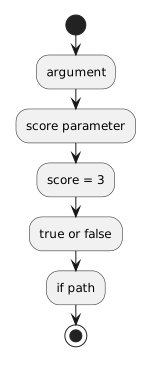
The parameter value becomes part of the Boolean expression.
The flow is:
 Argument.
Relational Operators Can Compare Local Variables
For example:
int difference = homeScore - awayScore;

if (difference > 0)
{
    System.Console.WriteLine("Home team is ahead.");
}
The calculation happens first.
The comparison then asks a question about the calculated value.
Relational Operators and Equality Ask Different Questions
This:
asks:
This:
asks:
Choose based on the requirement.
Keep Conditions Readable
A focused condition such as:
communicates one clear question.
More complex combinations of several Boolean conditions are taught later.
For now, master one comparison at a time.
The Main Idea
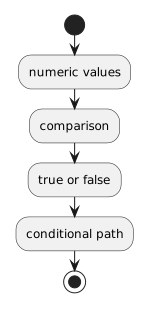
Relational operators turn numeric relationships into Boolean results:
 NumericValues.