A file is one way to store information persistently.
When a program writes information to a file, that information can remain available after the program closes.
The next time the program runs, it can read the file and recover the saved information.
This gives the application continuity across separate runs.
A text file contains characters that can be read as text.
For example, a file might contain:
Jordan starts at forward.
or:
Wildcats vs Rangers
North Field
Saturday
A person can often open a text file in a simple text editor and read its contents.
That makes text files a useful introductory storage format.
To work with a file, the program needs to identify it.
A file is located somewhere in the computer's file system.
It also has a filename.
For example:
lineup.txt
The .txt extension commonly indicates a text file.
The actual location used in your course application should come from the supplied project and instructions.
Do not invent file locations or move supplied files unless directed.
Two core operations are:
write
running program → file
and:
read
file → running program
Writing creates or updates persistent information.
Reading brings saved information into the current runtime state.
A program may do one, the other, or both.
Suppose the running program has a Player object with:
name = "Jordan"
jerseyNumber = 7
isAvailable = true
Writing a text file does not automatically save the entire object exactly as it exists in memory.
The code decides what text to write.
For example, it might write only:
Jordan
or:
Jordan,7,true
or a longer human-readable sentence.
The stored representation depends on the program.
This module focuses on simple text rather than full object serialization.
Imagine this sequence:
lineup.txt.The application is no longer running.
The file can still exist.
That is persistence.
Now imagine:
lineup.txt.The program recovered information created during an earlier run.
That is the practical value of persistent storage.
A file exists outside the current variables and objects in the running program.
That means file work can fail for reasons that ordinary in-memory assignments do not.
Examples can include:
Detailed exception handling is outside the current FIT scope.
For now, use the supplied file paths and heavily guided code so the focus stays on information movement.
Text files are excellent for seeing persistence because they are easy to inspect.
They are not the best storage format for every application.
Later technologies may use more structured approaches.
Do not generalize:
Programs should always save data in text files.
The correct conclusion is:
A text file is one understandable example of persistent storage.
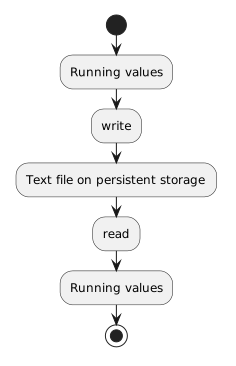
Keep this high-level model:
Running values
↓ write
Text file on persistent storage
↓ read
Running values
The file acts as the persistent bridge between different executions of the program.
The next two activities show how simple C# code can perform those write and read operations.