0.6.7 CSV Files

CSV Is a Simple Way to Store Structured Data

A CSV file stores tabular data as plain text.

CSV commonly stands for comma-separated values.

Instead of displaying data in spreadsheet cells, a CSV file represents rows and fields using text.

For example:
Plain text
Title,Artist,Genre,Year
Northern Lights,Example Band,Rock,2024
Side Street,Dana Lee,Jazz,2022

A spreadsheet can display the same information as a table:

Title Artist Genre Year
Northern Lights Example Band Rock 2024
Side Street Dana Lee Jazz 2022

The visible representations are different.

The underlying structured information is closely related.

Each Line Commonly Represents a Row

In this example:

Plain text
Title,Artist,Genre,Year
Northern Lights,Example Band,Rock,2024
Side Street,Dana Lee,Jazz,2022

the first line contains field names.

The next line describes one song.

The final line describes another song.

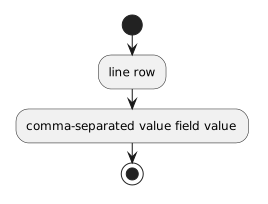
Conceptually:

Plain text
line → row
comma-separated value → field value

That makes CSV easy for many systems to create, exchange, and read.
The Header Gives Meaning to the Fields

The first line:

Plain text
Title,Artist,Genre,Year

acts as a header row.

It tells you what each position means.

For the line:

Plain text
Northern Lights,Example Band,Rock,2024

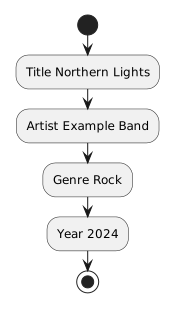
you can match values by position:

Plain text
Title  → Northern Lights
Artist → Example Band
Genre  → Rock
Year   → 2024

Without the header, the values would be much harder to interpret.

Field Order Matters

Consider:

Plain text
Northern Lights,Example Band,Rock,2024

The value Rock is meaningful because it appears in the position associated with Genre.

If the values are accidentally rearranged:

Plain text
Northern Lights,2024,Rock,Example Band

the text still exists, but the row no longer matches the expected structure.

Structured data depends on more than having the right values.

The values must appear in the correct fields.

CSV Is Plain Text

A CSV file can often be opened in a text editor.

That makes the separators visible.

The same file can also be opened or imported into spreadsheet software, which displays the values in rows and columns.

This gives CSV a useful role as an exchange format.

One program can write structured text.

Another program can read the same file and reconstruct rows and fields.

Commas Inside Data Need Special Handling

What if a song title contains a comma?

For example:

Plain text
Hello, Again

If the text were written directly as:

Plain text
Hello, Again,Example Band,Rock,2024

the commas would make it unclear where the title ends.

CSV formats can use quotation marks to preserve a field containing a separator:

Plain text
"Hello, Again",Example Band,Rock,2024

Now the comma inside the quoted title belongs to the value rather than separating two fields.

You do not need to implement a CSV parser in this module.

You do need to recognize that CSV has formatting rules beyond simply “split every comma.”

CSV Is Not the Same as a Spreadsheet Workbook

A spreadsheet workbook can contain:

A CSV file is much simpler.

It represents tabular text data.

When you save or export a worksheet as CSV, spreadsheet-specific features may not be part of that CSV representation.

This is why a .csv file and a spreadsheet workbook are not interchangeable artifacts.

CSV Supports Data Exchange

CSV is useful when information needs to move between systems.

Conceptually:

Plain text
system A
   ↓
CSV file
   ↓
system B

For example:

The file acts as a structured handoff.

A CSV File Still Needs Good Data Structure

CSV does not automatically make data clean.

A file can still contain:

CSV provides a format.

The quality and usefulness of the data still depend on how the records and fields are organized.

The next Learning Activity gives those parts more precise names.