The Internet and the Web Are Related, but They Are Not the Same Thing
People often use the words Internet and Web as if they mean exactly the same thing.
They are closely connected, but they describe different ideas.
A useful distinction is:
The Internet is the network infrastructure that connects computers and networks.
The Web is a system of linked resources and services that uses that network.
The Web depends on the Internet, but the Internet supports more than just the Web.
Think About Roads and Deliveries
A simple analogy is a road system.
The roads make travel between locations possible.
Different services can use those roads:
- package delivery;
- buses;
- emergency vehicles;
- personal travel.
The road system is not the same thing as any one service using it.
Similarly, the Internet provides connectivity.
The Web is one major service that uses that connectivity.
The analogy is limited, but it helps separate the infrastructure from one application built on top of it.
The Internet Connects Networks
The Internet is a global network of interconnected networks.
Devices and networks use agreed-upon communication technologies to exchange information across those connections.
Your device may reach the Internet through:
- a home network;
- a school network;
- a mobile network;
- another Internet-connected network.
The exact path between two systems can involve many networking devices and links.
You do not need to trace the full network path in this module.
The important idea is that the Internet provides the underlying connectivity.
The Web Uses Browsers, Servers, URLs, and Web Protocols
When you use the Web, you commonly interact with:
- a browser;
- a URL;
- a web server;
- a request;
- a response;
- HTML, CSS, images, and other web resources.
For example, you enter a web address into a browser.
The browser communicates with a server.
The server responds with information.
The browser interprets that information and displays a page.
That interaction uses the Internet as the communication network.
A Browser Is a Web Client
A browser such as a desktop or mobile browser acts as a client.
The client requests web resources.
A server provides responses.
This client/server relationship is central to understanding what happens when you visit a website.
The next Learning Activities follow that interaction more closely.
Websites Are Not Stored “In the Internet”
It is common to say:
That phrase is convenient, but it can hide the technical relationship.
Website resources are stored on systems that can be reached through networks.
The Internet provides the connectivity used to reach those systems.
The Web provides the conventions used to request, identify, transfer, and display web resources.
The Internet Supports Other Communication Too
The Internet can carry many forms of network communication.
The Web is one of them.
This is why:
is too broad.
The Web depends on Internet connectivity, but not every Internet-based communication is a webpage.
HTML and CSS Belong to the Web Layer of the Story
In the previous activities, you worked with:
- HTML page structure;
- CSS presentation;
- hexadecimal web colors.
Those artifacts become useful to a learner because a browser can retrieve and render web content.
The network connection underneath that interaction belongs to the Internet side of the story.
A simple view is:
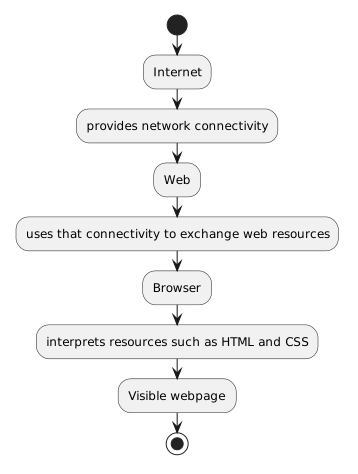 Internet.
Different Questions Point to Different Concepts
Ask:
That points toward the Internet.
Ask:
That points toward the Web.
Ask:
That points toward HTML.
Ask:
That points toward CSS.
Separating these layers makes the overall system easier to reason about.
The Main Distinction
Keep this concise relationship in mind:
Internet: the connected network infrastructure.
Web: a system of resources and communication that operates using that network.
The next activity focuses on the browser as the client in that web interaction.