Build the Diagram in Violet
- Create lifelines
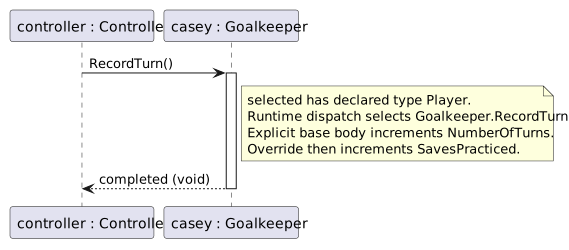
controller : Controllerandcasey : Goalkeeper. Keep only one receiver object. - Draw the solid request
RecordTurn()from controller to casey and start its activation. - Attach a note explaining
selected has declared type Player; runtime dispatch selects Goalkeeper.RecordTurn. - Continue the note with the actual work: the explicit base body increments NumberOfTurns, then the override increments SavesPracticed. End the activation and show the void completion.
- Save and identify the same receiver across reference assignment, dispatch, base work, and override work. None of those stages creates a base-class copy.
Compare the Completed Soccer Diagram
Compare this reference with the diagram you built in Violet. Layout may differ; the source meaning, labels, and relevant connections should agree.
- New
- Changed
- Removed
Trace One Interaction from Top to Bottom
After completion, NumberOfTurns and SavesPracticed are both 1. A plain Player receiver would execute only the Player body and would not have a SavesPracticed field.