Build the Diagram in Violet
- Create a Violet class diagram containing
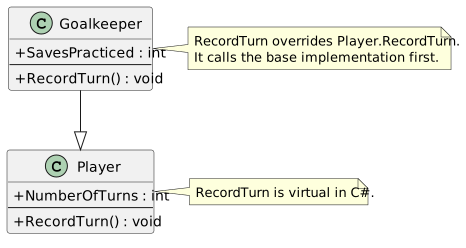
PlayeraboveGoalkeeper. - Put
+NumberOfTurns : intand+RecordTurn() : voidin Player's attributes and operations. Put+SavesPracticed : intand+RecordTurn() : voidin Goalkeeper's corresponding compartments. - Draw a solid generalization connector from Goalkeeper to Player, with a hollow triangle pointing at Player. Do not use a field association or dashed interface realization.
- Add notes beside the operation entries:
RecordTurn is virtual in C#for Player andRecordTurn overrides Player.RecordTurn and calls the base body firstfor Goalkeeper. - Save without redeclaring NumberOfTurns inside Goalkeeper. Its instance inherits that field even though the class compartment lists only the derived declaration.
Compare the Completed Soccer Diagram
Compare this reference with the diagram you built in Violet. Layout may differ; the source meaning, labels, and relevant connections should agree.
- New
- Changed
- Removed
Read the Contract One Part at a Time
Goalkeeper inherits NumberOfTurns; the class diagram does not need to redeclare that field in the derived compartment. The operation entry in Goalkeeper represents overriding, not another object.