Before accessing a two-dimensional score, decide what each dimension means. Here row 0 represents the Wildcats, row 1 represents a visiting team, and columns 0 through 2 represent three training rounds.
That convention makes every index pair interpretable. It is part of the application model; C# itself does not know what a team or round means.
| Team row | Round column 0 | Round column 1 | Round column 2 |
|---|---|---|---|
| 0: Wildcats | 2 | 0 | 3 |
| 1: Visiting team | 1 | 4 | 2 |
To find the visiting team's first-round score, choose row 1 and column 0. Moving to row 0 instead would select the Wildcats, even if the score happened to be the same in another example.
int[,] teamGoals = { { 2, 0, 3 }, { 1, 4, 2 } };
int visitingFirstRound = teamGoals[1, 0];
int wildcatsThirdRound = teamGoals[0, 2];
int teamCount = teamGoals.GetLength(0);
int roundCount = teamGoals.GetLength(1);
int scoreCount = teamGoals.Length;The initializer groups the rows
The first inner group contains row 0: 2, 0, 3. The next group contains row 1: 1, 4, 2. Each row has three columns, producing one rectangular array.
The two selected reads copy 1 into visitingFirstRound and 3 into wildcatsThirdRound. Reading those scores does not change the array.
Ask for the count of a particular dimension
teamGoals.GetLength(0) returns 2, the number of team rows. teamGoals.GetLength(1) returns 3, the number of round columns.
The argument to GetLength identifies a dimension. It is not a row or column position whose score you want to read.
What score does teamGoals[1, 1] read? How many total elements would an array with three teams and four rounds contain?
Solution
The read produces 4: visiting-team row 1, round column 1. A three-by-four array has 12 elements, with three valid row positions and four valid column positions.
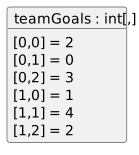
The diagram below shows the original example. Compare it with your prediction for the requested change; its pictured values have not been replaced by the practice inputs.
The first number in each pair identifies the team row. The second identifies the round column. The values match the earlier table and the C# initializer.