- New
- Changed
- Removed
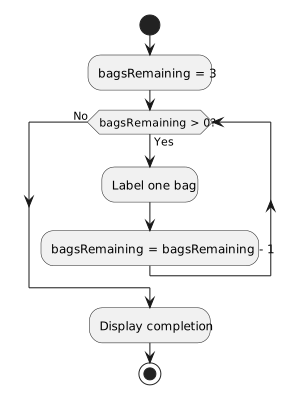
The Yes path reaches Label one bag and then the update. Its return edge reaches the decision without repeating the initialization. If the return edge went back before bagsRemaining = 3, every pass would reset the count and prevent completion.
The No path bypasses the body and reaches Display completion. A false condition is the normal exit; it is not an error path. Both outcomes must be labeled so a reader can tell when the body runs.
int bagsRemaining = 3;
while (bagsRemaining > 0)
{
    Console.WriteLine("Label one bag");
    bagsRemaining--;
}

Console.WriteLine("Labeling complete");
The first display models the labeling action in this short example. The second display belongs after the loop. The opening brace groups the repeated action and decrement together, just as the diagram places both on the return path.
An if activity diagram chooses a route and then continues forward. A while diagram also chooses a route, but one route eventually returns to the same condition. Without that return edge, the picture would describe checking and labeling at most one bag.
An end node inside the repeated body would end the activity on its first visit. Keep the final node after completion when the requirement is to label all remaining bags before finishing.