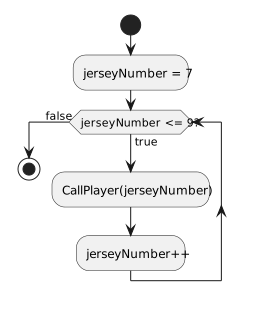
The coach wants the application to process jersey numbers 7, 8, and 9 in that order. Traversing a sequence means visiting its values and performing the intended work for each one.
Here, the loop generates consecutive numbers. For each visit, it calls a method that records the current number.
Work Through the Soccer Example
Place the field and both methods inside the existing Game class. CallPlayer stores its argument in LastCalledJerseyNumber so you can inspect the change. It does not display or announce anything.
jerseyNumber starts at 7. The comparison jerseyNumber <= 9 includes 9, and the update adds one.
Together these choices produce the visited values 7, 8, and 9. The next candidate, 10, is outside the permitted range.
Use the current value in the body
On the first pass, this.CallPlayer(jerseyNumber); passes 7 to the method. The parameter receives that value, and the assignment stores 7 in the Game field.
After the call returns, the loop update changes the local label to 8. The next body call therefore receives 8, not the original 7.
Observe the field after each assignment
Set a breakpoint on this.LastCalledJerseyNumber = jerseyNumber; inside CallPlayer. Inspect the parameter, then step over the assignment to inspect the stored field.
Across the three calls, the parameter values and newly stored field values are 7, 8, and 9. A breakpoint on an executable assignment makes each visit observable.
Observe the handoff from one visited value to the next
After CallPlayer stores 7, control returns to CallJerseyNumbers. Only then does jerseyNumber++ change the loop local to 8. The field still contains 7 until the next call stores 8.
That brief difference is expected: the local is the next candidate, while the field records the most recent completed call. At the failed test with local 10, the field remains 9 because no new call occurred.
Trace This Example
Trace each visited value and the exit
Local at condition
Condition
Argument passed
Field after the call
7
True
7
7
8
True
8
8
9
True
9
9
10
False
No call
9; unchanged
Read the Matching Activity Diagram
Visit Each Jersey Number in Order
NNew
CChanged
RRemoved
The initialization action sets the first candidate to 7. The true route calls CallPlayer with the current value, then advances that value before returning to the decision.
The call action represents the method that writes the Game field. At 10, the false route bypasses the call, so the last recorded field value stays 9.
Try a Focused Change
Predict and Explain
Check your reasoning
The first change visits 4, 5, and 6. The last call records 6, which remains in the field after the loop.
With start 7 and bound 6, the first test is false. There are no calls or recording assignments, so the fresh Game field remains 0.