Read the three parts of the header
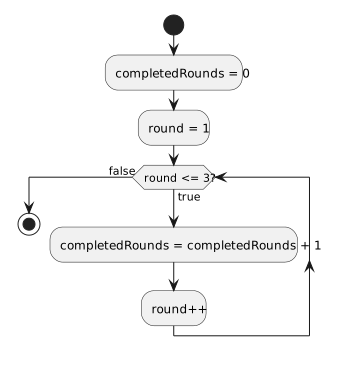
In for (int round = 1; round <= 3; round++), the semicolons separate three jobs. First create the round label, then test it, then update it after a completed body.
The update round++ adds one to round. In this header it performs the same increment as round = round + 1.
These parts execute at different times. They are not three statements that all run before the body.
Initialize once, then ask the first question
int round = 1 creates the loop local and gives it the value 1. Initialization happens once. The program then evaluates round <= 3.
Because 1 <= 3 is true, execution enters the braces. The body changes completedRounds from 0 to 1.
Update after the body
After that body execution, round++ changes the label from 1 to 2. Execution returns to the condition.
The second true check permits the second completion, and the update then changes the label to 3. The third true check permits the third completion.
A final false check stops repetition
After the third completion, the update makes round equal to 4. The next comparison, 4 <= 3, is false.
The body does not execute for 4. There are three body executions and four condition checks, leaving completedRounds at 3.
Connect this to variable scope
completedRounds is defined before the loop, so the surrounding method can use it afterward. The header local round belongs to the loop and is out of scope after its closing brace.
Separate the round label from the recorded result
In this example the header advances round, while the body advances completedRounds. The label chooses which planned round is being processed; the result records how many completions the body has modeled.
Keeping those jobs separate makes the header easier to trace. At the final false test, the candidate label is 4 but the result is still 3. No fourth completion was recorded.