An Object Parameter Can Reach the Caller's Object
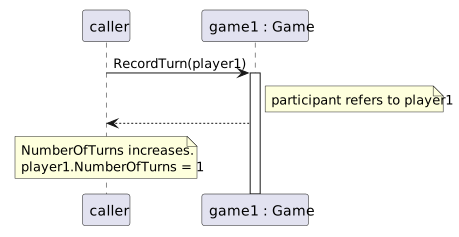
When a Player is passed to a method, the method receives a reference value. The caller's variable and the method parameter can reach the same Player during the call.
- New
- Changed
- Removed
When a Player is passed to a method, the method receives a reference value. The caller's variable and the method parameter can reach the same Player during the call.
Suppose a Game method contains:
public void RecordTurn(Player participant)
{
    participant.NumberOfTurns++;
}
`participant` is a reference to a Player. The increment changes a field on that Player object.
If `player.NumberOfTurns` was `0` before `game.RecordTurn(player);`, it is `1` afterward. The parameter variable stops existing when the call ends, but the Player and its changed field remain accessible through `player`.
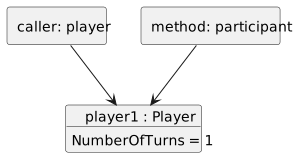
Two calls with `player` as the argument increment that Player twice. Its `NumberOfTurns` becomes `2`; there is no automatic Player copy for either call.
The statement `participant.NumberOfTurns++` changes the object. The statement `participant = new Player();` would instead change which object the parameter reaches. These statements have different effects on the caller's Player.