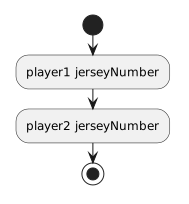
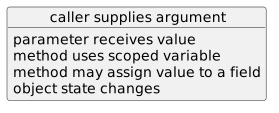
The parameter number is a variable available during that method call.
It receives the caller's argument.
It is not a permanent field on the Player object.
Compare the Two Names in One Assignment
This line:
this.jerseyNumber = number;
contains both ideas.
Field
this.jerseyNumber
belongs to the current Player object.
Parameter variable
number
belongs to the current method call.
The assignment copies the incoming value into the object's state.
Field State Can Remain After the Method Finishes
Suppose:
player1.SetJerseyNumber(7);
During the call:
number = 7
The method assigns:
this.jerseyNumber = number;
After the method finishes, the parameter number is no longer available as that active method parameter.
But the Player field can still contain:
jerseyNumber = 7
The field is part of the object's continuing state.
Local Variables Also Belong to Method Execution
C# methods can declare local variables.
A local variable belongs to the method or block scope where it is declared.
Later Learning Activities show how to declare, initialize, and use local variables in calculations and decisions.
For this page, the key distinction is:
Field
Parameters are one kind of method-level variable.
Do Not Turn Every Temporary Value into a Field
Suppose a method needs a value only while performing one task.
That value does not automatically need to become permanent object state.
Fields should represent information the object needs to keep as part of its design.
Method-level variables support the method's current work.
Do Not Use a Temporary Variable When the Requirement Is Object State
If the Player is required to remember its jersey number after SetJerseyNumber finishes, storing the value only in the parameter is not enough.
The method needs to transfer that value into the field:
this.jerseyNumber = number;
Scope Helps You Tell Them Apart
When reading unfamiliar source, ask:
Was the name declared in the class body?
It may be a field.
Was the name declared in a method parameter list?
It is a parameter.
Was the name declared inside a method body?
It is a local variable.
The declaration location helps reveal the role and scope.
The Debugger Shows Both Kinds of Information
While paused inside a method, debugger windows can show:
the current object and its fields;
the current parameter values;
later, local variables.
That lets you distinguish:
object state
from:
method execution state
The Module 1.4 Foundation
CO-038 establishes this information flow:
CallerSuppliesArgument.
NNew
CChanged
RRemoved
Later Module 1.4 activities add UML parameter notation, comparisons, null checks, multiple parameters, local variables, and more complex conditional logic.