Trace the Negated Result
- New
- Changed
- Removed
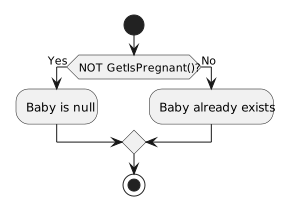
Compare if (this.GetIsPregnant()) with if (!this.GetIsPregnant()): the branch selected for each Animal flips. Parentheses in !(a && b) reverse the combined result, while !a && b reverses only a. Those are different expressions.
Trace the Outcome
Test once with Baby == null and once with a Baby object. Predict the original method’s return value, apply !, and then identify the branch taken. Do not use ! on a non-Boolean value.
The negation applies to the Boolean result of the method call, not to the Animal object. In !this.GetIsPregnant(), the method runs first and returns true or false; ! flips that result. If the method returns true, the code inside the if is skipped. Read the full condition aloud before tracing the branch.