Methods Represent Behavior
Fields describe object state.
Methods describe actions an object can perform.
For a Team class:
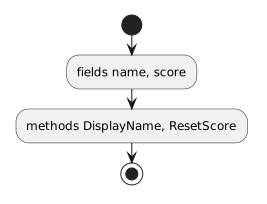
- New
- Changed
- Removed
This is a major step in object-oriented programming:
objects have state and behavior.
Fields describe object state.
Methods describe actions an object can perform.
For a Team class:
This is a major step in object-oriented programming:
objects have state and behavior.
A simple method can appear inside a class:
class Team
{
    public string name;

    public void DisplayName()
    {
        System.Console.WriteLine(this.name);
    }
}
The method belongs to Team.
When it runs for a specific Team object, this refers to that current Team.
If:
Team team1 = new Team();
team1.name = "Wildcats";
then:
team1.DisplayName();asks the team1 object to perform its DisplayName behavior.
Conceptually:
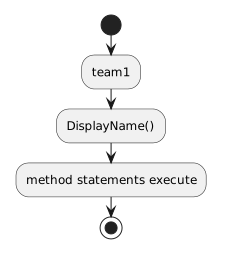
Normally, execution reaches the call:
team1.DisplayName();C# enters the method, executes its statements, and then continues after the call.
Detailed nested-call tracing comes in the next batch.
Inside Team:
this.nameaccesses the current Team object's field.
This connects prior object concepts to behavior.
If both team1 and team2 are Team objects:
team1.DisplayName();
team2.DisplayName();
the same method definition can execute for different current objects.
The object's state determines what the method sees through this.