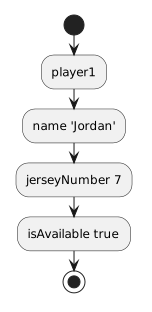
Suppose the UML object diagram shows:
player1 : Player
-------------------------
name = "Jordan"
jerseyNumber = 7
isAvailable = true
The object header tells you which instance exists.
The rows beneath it describe the selected field values for that instance.
Your C# code needs to establish the same intended state using the fields available on the supplied class.
Start with:
name = "Jordan"
Identify:
name;"Jordan".Then inspect the supplied C# Player class to confirm that a compatible name field exists.
A basic assignment can then establish that state on player1.
Conceptually:
player1.name = "Jordan";
The source connects the value to the specific Player object.
For:
jerseyNumber = 7
the corresponding assignment is conceptually:
player1.jerseyNumber = 7;
For:
isAvailable = true
the corresponding assignment is conceptually:
player1.isAvailable = true;
Together, the statements move the runtime object toward the state shown in the UML snapshot.
The UML value:
"Jordan"
is text.
The field should use a compatible text type.
The UML value:
7
is a whole number.
The field should use a compatible numeric type.
The UML value:
true
is Boolean.
The field should use a compatible Boolean type.
Do not turn every UML value into a quoted string.
Preserve the information type.
Suppose the diagram contains:
player1 : Player
name = "Jordan"
and:
player2 : Player
name = "Casey"
The code must preserve which value belongs to which object.
Conceptually:
player1.name = "Jordan";
player2.name = "Casey";
If those assignments are reversed, all the values still look valid individually.
The runtime model is still wrong.
Object identity and field value need to stay connected.
Suppose the Player class also has:
height
but the current UML does not include a height value.
Do not invent:
player1.height = 1.82;
merely because the field exists in the class.
The UML snapshot and current requirement determine which state you are expected to establish.
A newly instantiated object may begin with default values.
That does not mean the object already matches the UML.
If the UML requires:
jerseyNumber = 7
you need the runtime object to reach that state.
A default numeric value does not satisfy a different required value.
A statement such as:
player1.jerseyNumber = 7;
has two important meanings.
Assign the value 7 to the jerseyNumber field associated with player1.
Make the runtime state correspond to:
player1 : Player
jerseyNumber = 7
The second meaning is why the statement belongs in the code.
For one object, a mapping table can help:
| UML field | UML value | C# field type | Intended C# value |
|---|---|---|---|
name |
"Jordan" |
string |
"Jordan" |
jerseyNumber |
7 |
int |
7 |
isAvailable |
true |
bool |
true |
Use the actual fields and types from the supplied project.
The table helps separate:
After the assignments execute, the debugger can show the current runtime state.
Now compare:
player1 : Player
name = "Jordan"
jerseyNumber = 7
isAvailable = true
player1
name → "Jordan"
jerseyNumber → 7
isAvailable → true
The debugger gives evidence about whether the code produced the state the diagram describes.
For each field, keep this chain clear:
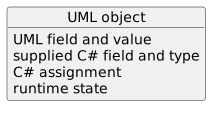
UML object
↓
UML field and value
↓
supplied C# field and type
↓
C# assignment
↓
runtime state
If something does not match, identify which link in the chain is wrong instead of changing unrelated code.