Verification Connects Claims to Evidence
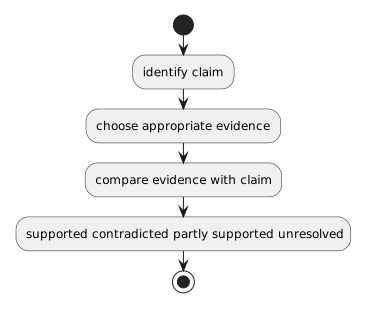
A verification process is:
- New
- Changed
- Removed
Two AI responses agreeing with each other is not the same as independent verification.
Artificial intelligence is a broad category.
AI systems can:
Different systems accept different inputs and produce different outputs.
Do not assume that every AI system has the same capabilities or access to the same information.
Generative AI can produce:
A generated response is not a guaranteed factual record.
The system produces output from its model, prompt, context, and available tools.
A prompt can include:
A more specific prompt can reduce ambiguity.
A detailed prompt still does not guarantee a correct answer.
Depending on the AI tool, input can include:
Share only information needed for the task and permitted for the system.
A response can sound:
and still be wrong or incomplete.
Important factual claims should be evaluated rather than accepted based on style.
Accuracy
A response can be strong in one area and weak in another.
Ask:
Missing context can make a generally reasonable response inappropriate for a specific situation.
A verification process is:
Two AI responses agreeing with each other is not the same as independent verification.
Choose a source based on:
Examples include current:
Share only what is needed.
Do not provide:
Use fictional or de-identified examples when they can accomplish the task.
Follow the AI-use requirements that apply to the current course or workplace.
When disclosure is required, accurately represent how AI contributed.
Do not present AI-assisted work in a way that falsely implies a different creation process.
Compare AI outputs for:
Agreement is not proof.
Disagreement creates a useful verification question.
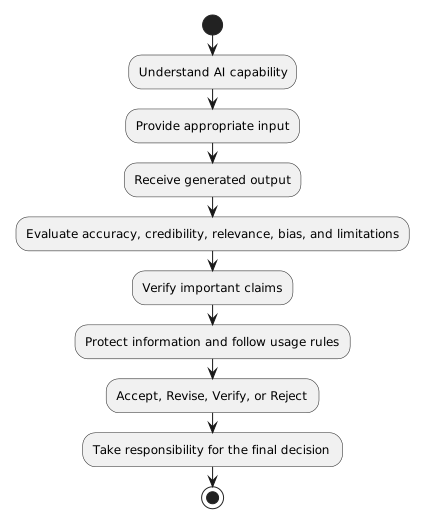
Use the framework to choose your next action.
Use the output when it fits the task and needs no meaningful correction or unresolved verification.
Change useful output that needs improvement.
Check an important factual claim with appropriate evidence.
Do not use an output that is substantially wrong, inappropriate, unsafe for the task, or outside the rules.
AI can produce information.
A human is responsible for deciding whether and how that information should be used.
Strong judgment includes:
An activity diagram can use partitions: