A table becomes easier to reason about when you can name its structure.
Consider:
| Song ID | Title | Artist | Genre |
|---|---|---|---|
| S001 | Northern Lights | Example Band | Rock |
| S002 | Side Street | Dana Lee | Jazz |
This dataset contains:
These terms are related, but they are not identical.
A record is a collection of related values describing one item.
In the music table:
S001 | Northern Lights | Example Band | Rock
is one song record.
The record describes one song using several fields.
Another row describes another song record.
For this dataset:
one record = one song
A different dataset could use:
one record = one artist
or:
one record = one album
The meaning depends on the table.
A field identifies one piece of information stored for each record.
In the song table, the fields are:
The Title field has the same meaning for every song record.
The values change from record to record.
The field definition remains consistent.
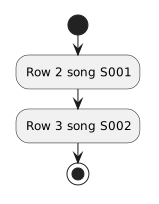
In a spreadsheet, one data row commonly represents one record.
For example:
Row 2 → song S001
Row 3 → song S002
The row is the visible spreadsheet structure.
The record is the logical data item represented by that row.
In a clean table, those ideas line up naturally.
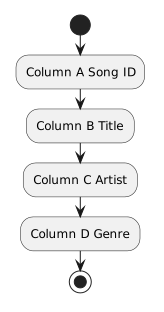
A spreadsheet column commonly represents one field.
For example:
Column A → Song ID
Column B → Title
Column C → Artist
Column D → Genre
Again, the column is the spreadsheet structure.
The field is the meaning assigned to that column.
A cell sits at the intersection of one row and one column.
Suppose:
B2 = Northern Lights
Column B represents Title.
Row 2 represents song S001.
Therefore the cell represents:
the Title value for song S001.
That is a useful way to reason about any structured spreadsheet cell.
The spreadsheet:
| Song ID | Title | Artist |
|---|---|---|
| S001 | Northern Lights | Example Band |
might appear in CSV as:
Song ID,Title,Artist
S001,Northern Lights,Example Band
The grid is gone.
The record-and-field structure remains.
That is why CSV can move structured data between systems.
A table becomes confusing if some rows represent songs and other rows represent artists.
For example:
S001 | Northern Lights | Example Band | Rock
A001 | Example Band | Milwaukee | 2018
The first row describes a song.
The second appears to describe an artist.
The columns no longer have one consistent meaning.
If different kinds of records need different fields, separate tables or worksheet tabs may be more appropriate.
Likewise, a column labeled:
Genre
should not contain:
Rock
Jazz
2024
Example Band
if 2024 and Example Band represent different concepts.
A field should have a stable purpose.
Consistency makes later sorting, filtering, and relationships much easier.
Once records and fields are consistent, the dataset can answer useful questions.
For example:
Which songs are Rock?
uses the Genre field.
Which record is S002?
uses the Song ID field.
Which artist is associated with Northern Lights?
uses the Artist field for that song record.
Structured questions depend on predictable structure.
Use this mental model:
Record
One logical item in the dataset.
Field
One defined piece of information about that item.
Row
The spreadsheet line commonly used to represent one record.
Column
The spreadsheet direction commonly used to represent one field.
Cell
One field value for one record.
Those concepts prepare you to recognize why consistency and unique identifiers matter.