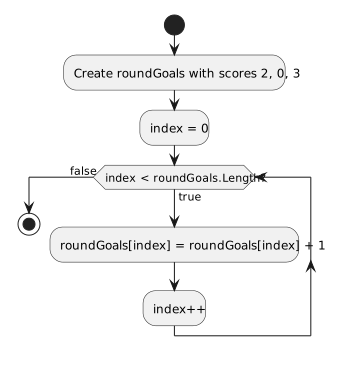
Use index zero for the first element
The local index begins at 0. The condition compares it with Length, which is 3. The first true check selects roundGoals[0].
The assignment reads its score 2, adds one, and stores 3 back in that same position.
Advance to the next position
The header update index++ adds one after the body. Indexes 1 and 2 are then processed in order. Each access uses the current index, so it targets a different score.
Stop before an invalid access
After index 2 is processed, the update makes index 3. The condition 3 < 3 is false. The body is skipped, so it never tries roundGoals[3].
An empty array needs no special body case
If the array has zero elements, the first comparison is 0 < 0. It is false and the body is skipped.
The same header works without manually copying an element count into the bound.
Use the index in the body, not a fixed position
The header alone does not guarantee every score is processed. The body must use the changing index. Writing roundGoals[0] = roundGoals[0] + 1; there would repeatedly change only the first score.
Trace both the index and the selected element. In the correct version they move together through positions 0, 1, and 2, leaving every position updated exactly once.