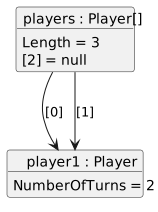
Begin with three null slots
new Player[3] allocates three positions for Player references. All three initially contain null. Length is 3 even though none of the positions initially reaches a Player.
Create a Player before reading its fields
players[0] = new Player(); creates one Player and stores its reference in index 0. The following field assignment can now reach that Player and set NumberOfTurns to 2.
Copying a reference shares the object
players[1] = players[0]; copies the reference from index 0 into index 1. Both positions now reach the same Player. No second Player was created.
A field change through either position would affect that one shared object.
An unused slot can cause a null-reference error
Index 2 is a valid position, but it still contains null. Reading players[2].NumberOfTurns would throw NullReferenceException.
The position exists; the Player through that position does not. Check the slot for null before using a Player field.
Follow each arrow to the object that owns the field
The NumberOfTurns field belongs to the Player object, not independently to each array slot. Because both arrows reach one Player, either slot provides a path to that same field.
Replacing a slot reference would be different from changing the field through it. A replacement redirects that one slot; a field update changes the object reached by every alias.