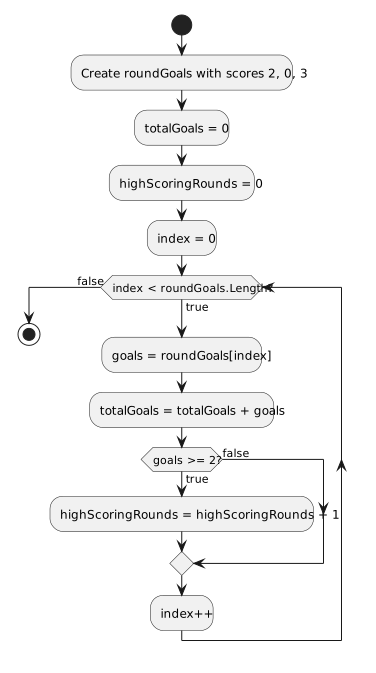
Visit every element with one consistent header
The loop visits indexes 0, 1, and 2. The local goals receives the current element value on each pass.
The boundary and update determine which positions are visited; the body determines what summary is built from their values.
Add an amount to produce a total
The totalGoals assignment adds the complete score each time. Its running values become 2, 2, and 5. It answers how many goals were recorded across all rounds.
Add one only when a condition is met
The highScoringRounds assignment runs only for scores at least 2. Scores 2 and 3 qualify; score 0 does not. The final event count is 2.
Do not add the score itself to this counter, because the question asks how many qualifying rounds, not their goal total.
Know whether the source array changes
This body reads elements into a local and changes summary variables. It never assigns into roundGoals[index], so the source scores remain 2, 0, 3.
An element-update pattern instead places the indexed element on the left side of an assignment.
Choose a summary before choosing its update
A total adds a magnitude: this round's number of goals. A qualifying-round count adds one: this round either meets the rule or does not.
The same element can contribute differently to both summaries. Score 3 adds three goals to totalGoals but only one qualifying round to highScoringRounds. Read the question before deciding what to add.