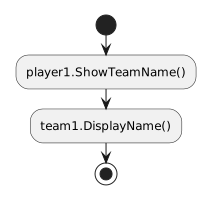
A Method Call Can Lead to Another Method Call
Consider:
The ShowTeam method contains:
public void ShowTeam()
{
    this.DisplayName();
}
Then DisplayName contains:
public void DisplayName()
{
    System.Console.WriteLine(this.name);
}
Execution does not stay on one source line.
It moves through a sequence of method calls.
Trace from the Original Call
Start with:
The first receiver is:
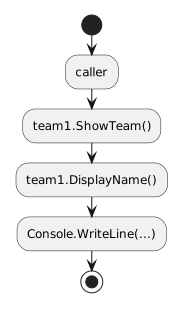 Caller.
Each new method call temporarily moves execution into another method.
When the called method finishes, execution returns to the statement after the call in the previous method.
Use a Trace Table
A small trace can be organized as:
This helps prevent the common mistake of assuming this always refers to the same object through the entire call chain.
Sequence Diagrams Visualize the Same Trace
A conceptual sequence diagram may show:
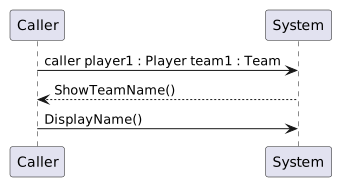 CallerPlayer1PlayerTeam1Team.
The vertical order shows call order.
The horizontal direction shows which object receives each message.
Return Values Are Not Part of This Trace Yet
Every method in the current examples is void.
Methods still finish and return execution to their caller.
They simply do not return a data value.
Methods that return values are taught later.
Do Not Skip Calls When Explaining Execution
A weak trace might say:
That may be the visible result, but it hides how execution reached that result.
A stronger trace explains:
That explanation connects source structure to runtime flow.
The Main Tracing Questions
At every method call, ask:
- Which object receives the call?
- Which method begins?
- What does this refer to inside that method?
- Does that method call another method?
- Where will execution return when the method finishes?
Those questions prepare you to use debugger stepping and the Call Stack in CO-037.