An AI system needs information to work with.
That information is the input.
For a text-based generative AI system, the input often includes a prompt.
A prompt is the instruction, question, or context provided to guide the system's response.
Example:
Explain offside in soccer for someone who has never played before.
The AI system receives that prompt as input.
The generated explanation is the output.
Depending on the AI system, input can include:
A prompt is therefore one important part of the input, not necessarily the only input.
The system can only work with information that is available to it through its model, context, tools, and current interaction.
The output is what the AI system returns.
For example:
Prompt:
Give me three possible subject lines for an email to a soccer coach about missing practice.
Output:
1. Unable to Attend Practice Tuesday
2. Practice Absence — Tuesday
3. Notice About Tuesday's Practice
The output is generated content.
It becomes information for the user to evaluate and possibly use.
Compare:
Help with an email.
with:
Draft a concise email to my soccer coach explaining that I will miss Tuesday's practice because of a class event. Use a professional and respectful tone.
The second prompt tells the system more about:
That reduces ambiguity.
This is similar to the precision work you practiced when writing programming instructions.
Suppose you want help summarizing a match report.
A prompt such as:
Summarize this report in three bullet points for the coach:
[pasted report]
provides both:
The system now has a clearer basis for the generated output.
A prompt should include information that helps complete the task.
Unrelated details can make the request harder to interpret.
For example, if the goal is to rewrite a short practice reminder, the system probably does not need unrelated information about every player on the roster.
A focused input makes the task clearer.
Later activities will examine responsible decisions about what information should and should not be shared.
A prompt can state requirements such as:
Use plain language.
Limit the response to one paragraph.
Explain the idea for a beginner.
Use a table with two columns.
These constraints do not guarantee a perfect result.
They help define what a useful result should look like.
Suppose the prompt is:
Write a short welcome message for a new soccer player.
Several different messages could satisfy the task.
Generative AI often works in spaces where more than one valid output is possible.
That is different from asking a calculator for:
7 + 5
where one exact numeric answer is expected.
AI work can be iterative.
For example:
Prompt 1 → first draft
Then:
Prompt 2:
Shorten that draft and make the main action clearer.
The earlier response can become context for the next request.
This lets the user refine a result over several turns.
Writing a detailed prompt can improve task clarity.
It does not guarantee that the generated information is correct.
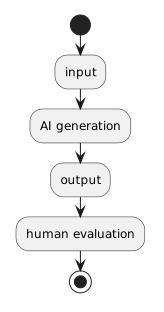
The relationship is:
input
↓
AI generation
↓
output
↓
human evaluation
The next activity explains why the generated output must not be treated as guaranteed fact.