Generative AI can produce text that is:
Those qualities describe how the answer is presented.
They do not prove that the information is correct.
An AI-generated response can contain an error while sounding completely certain.
That is why appearance and accuracy must be evaluated separately.
A generative AI system uses its model, prompt, context, and available tools to generate an output.
It is not automatically checking every statement against an authoritative source before presenting it.
A response can therefore include:
The user should treat the response as generated output, not guaranteed evidence.
Imagine an AI response says:
The sentence is specific.
That specificity does not prove that the system had access to the real schedule.
The time and field could be:
The more a task depends on an exact fact, the more important it becomes to notice whether that fact has real support.
Suppose a user asks:
but the AI does not have the instructor's announcement.
A generated answer may still sound plausible if the system tries to be helpful.
The correct response depends on actual course information that may not be available.
A useful habit is to ask:
An AI response may sometimes mention:
A citation-shaped detail is still generated output unless the system actually retrieved or was given the source.
Do not assume that a source exists because its title looks realistic.
Some questions depend on information that changes:
An AI system may or may not have access to current external information.
A model that cannot access current information cannot reliably know a change that occurred after the information available to it.
Always distinguish:
general knowledge
from:
current factual state.
If the prompt contains an incorrect assumption, the output may continue from that assumption.
For example:
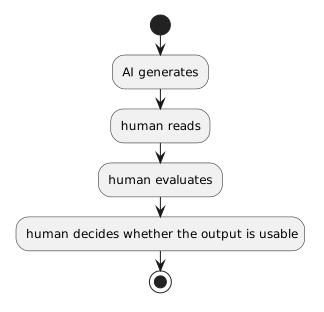
The next Learning Activity focuses on three qualities to examine during that evaluation: accuracy, credibility, and relevance.