A Simple Decision Flow
Conceptually:
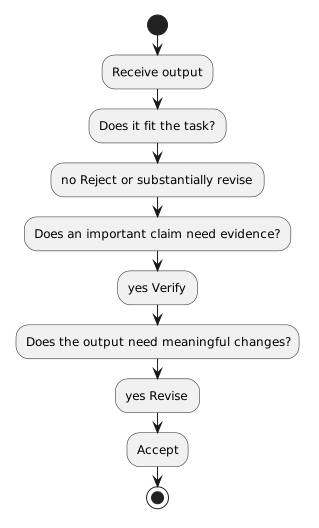
- New
- Changed
- Removed
Real decisions are not always perfectly linear.
The model helps make your reasoning visible.
After receiving an AI response, you need to decide what to do with it.
A useful four-part framework is:
These choices are not grades for the AI.
They describe your next action.
Choose Accept when the output is appropriate for the task and does not require meaningful correction or additional verification before use.
This is most appropriate when:
Example:
If one heading fits the purpose, accepting it may require little additional work.
Choose Revise when the response is useful but needs changes.
Reasons can include:
Example:
An AI drafts a professional message correctly but includes a detail you do not want to share.
You can remove the unnecessary detail and revise the message.
Choose Verify when an important claim needs evidence before you can rely on it.
Examples include claims about:
Verification means finding appropriate evidence and comparing it with the claim.
Do not treat "Verify" as a permanent final state.
After checking the evidence, you may:
Choose Reject when the output should not be used.
Reasons can include:
Rejection can be the most responsible choice when revision would require rebuilding nearly everything.
Suppose an AI-generated technical explanation contains:
You might:
The framework can be applied to parts of a response rather than only to the response as one block.
A creative wording suggestion and a factual technology recommendation do not carry the same risk.
For low-risk creative work, acceptance may be reasonable quickly.
For a claim that could affect:
verification may be necessary even when the answer sounds convincing.
Weak justification:
Stronger justification:
Weak justification:
Stronger justification:
Conceptually:
Real decisions are not always perfectly linear.
The model helps make your reasoning visible.
AI produces the output.
You decide whether the output is usable.
The important skill is not choosing the same action every time.
It is choosing an action that matches: