In the supplied FIT weather activity, the C# application can open a weather-related webpage.
The browser displays information.
A person can look at the result and answer a question such as:
Is it raining?
That answer can then become a Boolean value used by the program.
The important flow is:
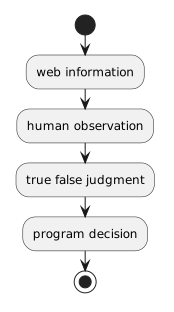
web information
↓
human observation
↓
true/false judgment
↓
program decision
The human is deliberately part of the system.
Suppose the browser displays current weather information.
The learner reviews the page and concludes:
It is raining.
That observation can be represented in the supplied application as:
isRaining = true
If the learner concludes that it is not raining:
isRaining = false
The program can now use a Boolean value it already knows how to evaluate.
The program is not reading the webpage and discovering the weather by itself.
The person is interpreting the web information.
That distinction matters.
The workflow is not:
website → C# automatically understands weather
It is:
website → person observes result → person supplies decision state → C# uses Boolean
This keeps the program logic simple while still connecting web information to software behavior.
You have already read C# decisions such as:
if (isRaining)
{
System.Console.WriteLine("Choose rain gear.");
}
The new part is not the if.
The new part is where the Boolean state came from.
Earlier, isRaining may have been supplied directly by the program.
Now the value can represent a human judgment based on information observed on the Web.
if/else Can Represent Two OutcomesA simple example is:
if (isRaining)
{
System.Console.WriteLine("Choose a rain jacket.");
}
else
{
System.Console.WriteLine("Choose a hoodie.");
}
Read the code using the Boolean value.
If:
isRaining = true
the first branch runs.
If:
isRaining = false
the else branch runs.
The conditional reasoning is the same as Module 0.3.
The information source is different.
The webpage provides information.
The learner interprets that information.
The learner's true/false judgment becomes the input to the decision.
Those are three different stages.
For example:
Evidence
The webpage reports rain at the selected location.
Human interpretation
I judge that the answer to “Is it raining?” is yes.
Program state
isRaining = true
Program behavior
Follow the true branch.
Keeping those stages separate makes it easier to explain why the program behaved as it did.
A person can misread the page.
The page can show information for the wrong location.
The URL can contain the wrong query value.
The displayed information can also change over time.
That is why the complete evidence chain matters.
If the program chooses an unexpected clothing result, inspect the process:
if or if/else logic follow the expected branch?The final program output is only the end of the chain.
A browser can display incorrect, outdated, incomplete, or misunderstood information.
This module does not yet focus on evaluating source credibility in depth.
It does establish an important habit:
Observe what the source actually says before turning it into a program decision.
Later course work will place more emphasis on evaluating digital information and evidence.
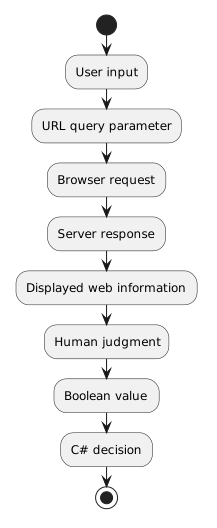
This one activity brings several Module 0.5 ideas together:
User input
↓
URL + query parameter
↓
Browser request
↓
Server response
↓
Displayed web information
↓
Human judgment
↓
Boolean value
↓
C# decision
You have moved from understanding the Web as a client/server system to using web information as part of a simple software decision.