The industry standard for writing in C# is called camel casing. What this means is that in order to avoid spacing and uncommon symbols, phrases are generally written in a format that is squished together but still easy to read. An example of this is: stilleasytoread vs stillEasyToRead. The second example is compact but still legible because there is a clear indication of the start of words whereas the first one can be difficult to read.
While it is the standard to start camel casing with a lower-case word and then move to upper-case words, for the beginning weeks of this course many fields will be written with an UppercaseLetterFirst. Once fields are made private, all fields as well as their references will need to change to regular camel casing.
When naming fields, the name can be whatever you would like. However, most of the time it is best practice to keep field names as close to their class name as possible.
In this course you will be given the names of fields and they will need to be used exactly. A good portion of errors that occur are because of naming issues so it will be incredibly important to pay attention to how fields are named/spelled.
As an example, I have this field named Snack of type Food in the Employee class.
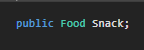
This doesn't harm anything and may help me remember what I want to use that field for, but what if the Employee wants to eat Food that isn't a Snack? Then you may have a situation where the Employee is eating a whole Meatloaf that many people would consider a meal rather than a snack.
It is normal, then, for fields to be named as their class name so they are the most generic version of what they can be.
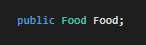
Now we don't have to worry about what kind of thing the Food might be. A Monkey Tail is Food and Meatloaf is Food.
Variables and Parameters will always follow conventional camel casing rules and can generally be named whatever you please. Many times throughout the course we will give you variable/parameter names for debugging purposes, but they are not required.