Use using System.Collections.Generic; at the top of the C# file, before its class definitions. Place the following statements inside an existing method.
List<int> roundGoals = new List<int>();
roundGoals.Add(2);
roundGoals.Add(0);
roundGoals.Add(2);
roundGoals.Add(3);
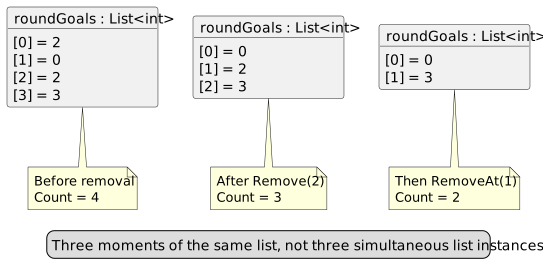
bool removed = roundGoals.Remove(2);
Remove searches for the supplied item and removes only its first match. removed becomes true; the remaining values are 0, 2, 3. A missing value produces false and leaves the list unchanged.
roundGoals.RemoveAt(1);Before this call the list is 0, 2, 3. Index 1 holds 2, so the list becomes 0, 3 and Count becomes 2. Later entries shift left. RemoveAt returns no result value and throws ArgumentOutOfRangeException for an invalid index. Check that the index is at least 0 and less than Count before using an uncertain position.
These examples use the established Player class and its public integer field NumberOfTurns.
Player jordan = new Player();
jordan.NumberOfTurns = 2;
Player casey = new Player();
casey.NumberOfTurns = 1;
List<Player> players = new List<Player>();
players.Add(jordan);
players.Add(casey);
players.Add(jordan);

bool removedJordan = players.Remove(jordan);
For this Player class with no custom equality behavior, Remove matches the same object reference. The remaining entries are Casey at index 0 and Jordan at index 1. removedJordan is true. Only one Jordan entry was removed, and the Jordan variable still reaches the same Player.
Player anotherPlayer = new Player();
anotherPlayer.NumberOfTurns = 2;
bool removedAnother = players.Remove(anotherPlayer);
removedAnother is false. The new Player has the same turn count as Jordan but a different identity. To remove whichever object occupies a known position, use RemoveAt with that position instead.
- New
- Changed
- Removed