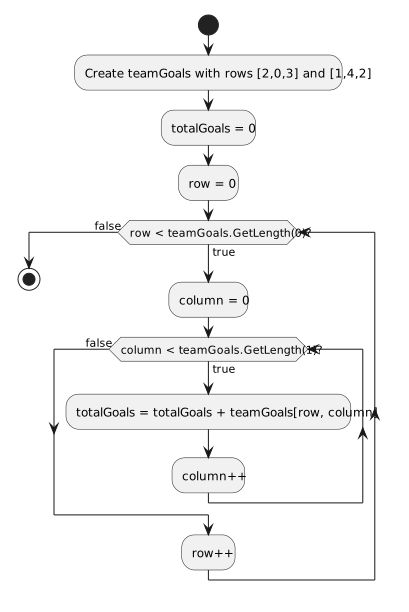
Total both teams across all rounds
int[,] teamGoals = { { 2, 0, 3 }, { 1, 4, 2 } };
int totalGoals = 0;

for (int row = 0; row < teamGoals.GetLength(0); row++)
{
    for (int column = 0; column < teamGoals.GetLength(1); column++)
    {
        totalGoals = totalGoals + teamGoals[row, column];
    }
}
The outer body holds a complete column traversal
The outer loop first selects row 0. Its body defines column at 0 and runs the inner loop through columns 0, 1, and 2.
The addition therefore reads pairs [0,0], [0,1], and [0,2] before the outer update changes the row.
Restart the inner index for the next row
When row becomes 1, execution enters the outer body again. The inner header defines a fresh column local initialized to 0.
It visits [1,0], [1,1], and [1,2]. Starting columns at zero for each row is what prevents the second team's scores from being skipped.
Trace All Six Additions
The inner body executes six times, but the outer body executes twice. The row label does not advance after each score; it advances after an entire column traversal.
The total is initialized before both loops, so the second row continues adding to the first row's total rather than starting over.