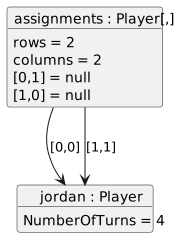
The established Player class has a public int field named NumberOfTurns. Place these statements inside an existing method. Jordan is deliberately assigned to two different schedule positions.
Record scheduled turns without reading through null
Player[,] assignments = new Player[2, 2];
Player jordan = new Player();
jordan.NumberOfTurns = 2;

assignments[0, 0] = jordan;
assignments[1, 1] = jordan;

int occupiedSlots = 0;

for (int session = 0; session < assignments.GetLength(0); session++)
{
    for (int station = 0; station < assignments.GetLength(1); station++)
    {
        Player current = assignments[session, station];

        if (current != null)
        {
            current.NumberOfTurns = current.NumberOfTurns + 1;

            occupiedSlots++;
        }
    }
}
The rectangular array stores references
Creating new Player[2, 2] creates four reference positions, initially null. Creating jordan is a separate operation.
The two element assignments copy Jordan's reference into [0,0] and [1,1]. They do not create two additional Players.
Check each slot before using a field
The nested loops read one slot into current. At [0,1] and [1,0], that value is null, so the if skips both body assignments.
At an occupied position, the program can reach the Player and record one turn. The index pair may be valid even when no Player occupies that position.
Trace Positions and Shared State