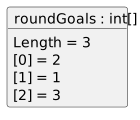
The left side chooses where to store
In roundGoals[1] = 1;, the index 1 selects the second position. The right-side int value 1 is stored there.
The two occurrences of 1 have different roles: one selects a position and the other is the replacement score.
Only the selected position changes
After the assignment, the sequence is 2, 1, 3. Index 0 still stores 2 and index 2 still stores 3. Length remains 3.
The operation does not insert a position or shift any existing score.
A later read sees the replacement
The final assignment reads index 1 again, so correctedScore receives 1. Reading the same element before the replacement would have produced 0.
An invalid target is still an error
Assigning through an index must obey the same bounds as reading. Using index 3 here would not append a score; it would attempt an out-of-range access.
Compare a stored copy with the corrected element
A local that received a score before a correction keeps its earlier int value. Replacing an array element updates that element; it does not locate and rewrite every local that previously read it.
Read the element again when you need its current score. This makes the timing of the read important when you compare a debugger local with the array after a correction.