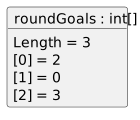
Read the values from left to right
The braces contain the values to store. The first value, 2, goes into index 0. The next value, 0, goes into index 1. The final value, 3, goes into index 2.
Commas separate values; the square brackets in int[] still identify the variable type.
Let the initializer determine the count
There are three listed values, so the created array has three elements. Appending a fourth listed score would create a four-element array instead.
Unlike a bare definition, this initialized definition creates an instance and assigns its reference to the local.
Each value must fit the element type
The element type is int. All listed scores must be compatible with that type. A text description such as Two goals is not an int score.
A zero score is still an element
The middle zero occupies a real position. It records a round with no goals in this model. It does not remove that round from the sequence or shift the next score into its place.
Preserve the connection between order and rounds
Suppose the coach reports 2 goals, then 0, then 3. The initializer must preserve that order if each position represents the next training round. Rearranging the values would preserve the total but misrepresent individual rounds.
Check both the number of values and their order. An initializer is useful here because all three scores are known when this statement executes; it does not mean later scores can never be corrected.