A Message Shows Who Receives the Call
A sequence diagram's call arrow points to the object receiving a method call. An object reference passed as an argument appears in the message label.
- New
- Changed
- Removed
A sequence diagram's call arrow points to the object receiving a method call. An object reference passed as an argument appears in the message label.
Consider a Controller calling a Game method:
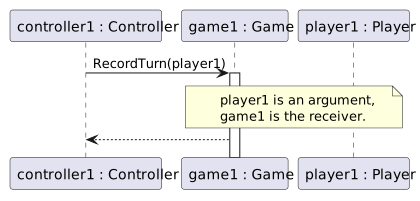
game1.RecordTurn(player1);The call arrow goes from `controller1 : Controller` to `game1 : Game`. It is labeled `RecordTurn(player1)`. The label identifies `player1 : Player` as the argument.
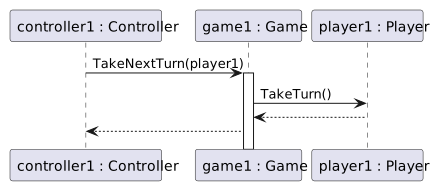
Inside Game's method, the Player parameter receives a copy of the reference supplied by `player1`. The method can therefore access that Player without the call arrow pointing to the Player.
If Game subsequently calls `participant.TakeTurn()`, the diagram has another message from Game to Player, placed later on the timeline. A field assignment such as `participant.NumberOfTurns++` is not itself a method call message.
The controller's message reaches Game first. Any later call Game makes on Player happens while Game's method is running. That vertical order explains the interaction more clearly than the argument label alone.