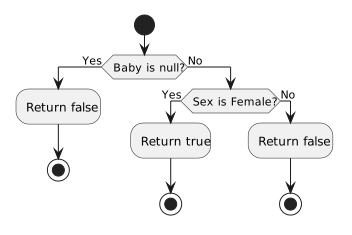
A returning method can contain:
That means debugging requires you to answer two questions:
Consider:
public string GetPlayerMessage()
{
if (this.isAvailable)
{
if (this.position == "Goalkeeper")
{
return "Available goalkeeper";
}
return "Available field player";
}
return "Unavailable";
}There are several possible return paths.
Before stepping into the conditions, inspect:
this.isAvailable
this.positionSuppose:
isAvailable = true
position = "Goalkeeper"Predict:
outer if → true
inner if → true
return "Available goalkeeper"Then use the debugger to test that prediction.
For nested conditions, do not jump directly to the return you expect.
Follow execution order:
outer condition
↓
selected branch
↓
inner condition if reached
↓
selected returnThis prevents you from attributing a return to a condition that was never evaluated.
Suppose the method is:
public string GetTeamName()
{
if (this.team == null)
{
return "No team";
}
return this.team.name;
}If:
this.team = nullthe first return should execute.
The method should end before reaching:
return this.team.name;If you expect the later return to run too, your mental model of return is incorrect.
A useful debugger workflow is:
The debugger makes both the conditional path and return path visible.
While inside the returning method, the Call Stack contains that method above its caller.
After the return executes, the method leaves the active stack and the caller resumes.
That is evidence that the return ended the current method.
Suppose:
public string GetGoalCategory(int goals)
{
if (goals >= 3)
{
return "Two goals";
}
return "Fewer than three";
}For:
goals = 4the condition correctly selects the first branch.
The wrong string is returned.
The defect is in the returned value, not in the condition.
Now suppose:
public string GetGoalCategory(int goals)
{
if (goals > 3)
{
return "High scoring";
}
return "Fewer than three";
}For:
goals = 3the first condition is false.
If the requirement says 3 should count as high scoring, the defect is the comparison boundary.
The returned strings may be correct for their branches, but the wrong branch is selected.
Suppose C# reports that not all code paths return a value:
public string GetAvailabilityText()
{
if (this.isAvailable)
{
return "Available";
}
}Trace both possibilities.
A return is reached.
The method reaches its end without returning a string.
The compiler message points to incomplete path coverage.
Suppose:
public string GetTeamName()
{
if (this.team == null)
{
return "No team";
}
return this.team.name;
}The caller unexpectedly receives:
"No team"Inspect:
this.teamIf it is null, the return is consistent with the current runtime state.
The actual defect may be earlier, where the Team relationship should have been assigned.
A returned result may depend on:
When the result is wrong, work backward.
For example:
wrong returned string
↑
selected return statement
↑
selected conditional branch
↑
Boolean expression
↑
runtime field/parameter valuesThis helps locate the earliest incorrect state or decision.
A returning conditional method is not well understood after testing only one input.
For a method with three possible returns, inspect representative values that reach each return.
For example:
goals = 4 → high-scoring return
goals = 2 → two-goal return
goals = 0 → remaining returnThe purpose is to understand each path, not merely the most common one.
CO-046 focuses on value returns such as:
int
double
bool
stringReturning object references is taught later.
Keep the debugging target within the current module boundary.
A strong explanation sounds like:
That explanation connects runtime state, decision logic, return flow, and requirement.
Conditional returns become manageable when you trace one complete path from input to returned result.