A sequence diagram should communicate:
When the Feedback System reports a sequence-diagram error, treat the message as evidence that one of those elements differs from the expected interaction.
Common introductory sequence-diagram problems include:
Class-diagram field errors and object-diagram value errors belong to different UML forms.
Suppose the expected interaction is:
player1 : Player ── DisplayName() ──> team1 : Team
but the diagram sends:
DisplayName()
back to player1.
The method name may be correct.
The receiver is wrong.
The diagram must show the object whose method actually executes.
Suppose the source interaction is:
team1.ResetScore();
team1.DisplayName();
The sequence diagram should show:
ResetScore()
before:
DisplayName()
because vertical position represents time.
Correct messages in the wrong order still describe the wrong interaction.
A participant may be labeled conceptually as:
team1 : Team
where:
team1
is the object identity and:
Team
is the type.
Do not replace the current object identity with only the class name when the interaction requires a specific object instance.
The current Module 1.3 sequence diagrams focus on parameterless void methods.
If a feedback message seems confusing, do not solve it by adding:
Those concepts belong to later modules.
Stay inside the current teaching boundary.
If three messages are correct and one receiver is wrong, keep the three correct interactions.
Make a focused correction.
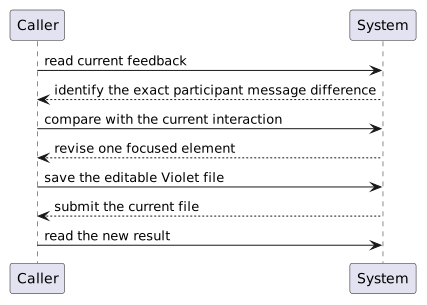
A useful workflow is:
read current feedback
↓
identify the exact participant/message difference
↓
compare with the current interaction
↓
revise one focused element
↓
save the editable Violet file
↓
submit the current file
↓
read the new result
A sequence diagram is not correct because the arrows look balanced or evenly spaced.
Meaning comes from:
Model the source interaction rather than arranging arrows for appearance.
For example:
player1receivesShowTeamName(). While that method is active,player1callsDisplayName()onteam1.
If the diagram cannot support that sentence, the interaction is still unclear.
The goal is not only to remove the Feedback System error.
The goal is to make the diagram accurately represent the required method-call interaction.