Generative AI refers to AI systems designed to produce new content in response to input.
Depending on the system, the output can include:
A text-based generative AI system might receive:
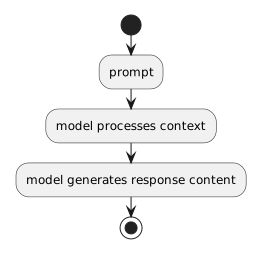
The technical implementation can be far more complex than this simplified flow.
For FIT, the important idea is that the response is generated, not retrieved as guaranteed truth.
Generation does not always mean creating something from nothing.
A generative AI system can also transform supplied content.
Examples include:
The user's input becomes context for the generated result.
A learner might use generative AI to:
These uses can be helpful because the system can quickly produce candidate content.
Candidate content still needs evaluation.
A polished response can sound confident and complete.
That presentation does not prove that every claim is correct.
The system is generating an answer.
It may produce:
The quality can vary across tasks and prompts.
One generative AI system may work only with text.
Another may also accept:
Some systems may have access to external tools or current information.
Others may not.
Do not assume that one AI tool's capabilities apply to every other AI tool.
Compare:
with:
The second prompt provides:
That additional information helps define the requested output.
The next Learning Activity looks more closely at prompts, inputs, and outputs.
Generative AI is not simply choosing arbitrary words or pixels.
The output reflects patterns represented in the model and the context of the request.
At the same time, generation is not a guarantee of factual correctness.
Those two ideas belong together:
The output is pattern-based and purposeful.
The output still needs human evaluation.