Compare Multiple Real Examples
Suppose you are interested in:
- New
- Changed
- Removed
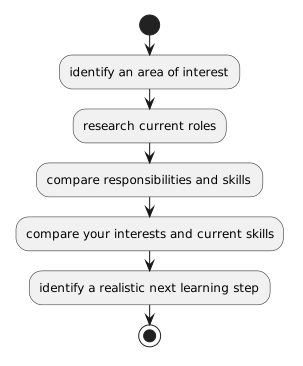
The goal is not to choose one permanent career immediately.
The goal is to make your next decision with better information.
"Working in IT" does not describe one job.
Technology organizations need people who work with:
Different roles emphasize different combinations of technical and professional skills.
Job titles vary between organizations.
Instead of relying only on the title, examine what the person actually does.
Common role families can include work such as:
Helping users solve hardware, software, access, or configuration problems.
Designing, building, testing, and maintaining software.
Supporting the systems that connect devices and services.
Helping protect systems, accounts, information, and operations.
Organizing, analyzing, presenting, or managing data.
Building or maintaining web content, interfaces, or related systems.
These categories overlap.
One job can include responsibilities from several areas.
A role is easier to understand when you identify real work activities.
For example, an entry-level support role may involve:
Those are more informative than a stereotype such as:
Technical roles often require:
Those skills appeared throughout FIT.
A debugger may help reveal a technical problem.
A professional still needs to explain the problem clearly to another person.
A person may begin in one area and later move into another.
For example, experience in:
can expose a person to other roles and interests.
A pathway can include:
The useful next step depends on the role and organization.
Job expectations can change.
When researching one role, use current evidence such as:
Avoid treating one AI-generated career description as the complete definition of a job.
Suppose you are interested in:
The goal is not to choose one permanent career immediately.
The goal is to make your next decision with better information.