0.7.7 Evidence and Verification

A Claim Becomes More Useful When You Can Support It

AI can generate factual claims quickly.

Before relying on an important claim, ask:

What evidence supports this?

Verification means checking a claim against appropriate evidence.

The goal is not simply to find another page that repeats the same statement.

The goal is to determine whether the claim is supported by information that is relevant and trustworthy for the task.

Start by Identifying the Claim

Suppose an AI response says:

Your course project is due Friday at 11:59 p.m.

Before verifying it, separate the claim:
Plain text
Due date = Friday
Due time = 11:59 p.m.

Now you know what needs evidence.

A vague reaction such as:

I should fact-check this whole response

is less useful than identifying the exact claim that could affect your action.

Decide Whether the Claim Needs Verification

Not every AI-generated sentence requires the same level of checking.

A creative suggestion such as:

Try the heading "Getting Started"

does not carry the same factual risk as:

The assignment closes at midnight tonight.

Verification matters most when an incorrect claim could affect:

Use Evidence That Matches the Claim

Suppose the claim concerns a course deadline.

Useful evidence may include:

A random blog post about typical college deadlines would not answer the question.

The evidence needs to address the same claim.

Independent Support Is More Useful Than Repetition

Imagine an AI response says:

Visual Studio setting X is required.

Then another AI response says the same thing.

You now have two generated statements.

You do not automatically have verified evidence.

Verification improves when you compare the claim with an authoritative technical source, current course requirement, or other appropriate evidence.

Verify the Important Detail, Not Just the General Topic

Suppose the AI says:

The software is supported, and version 17.14 is required.

A source confirming that the software exists does not verify the version requirement.

The evidence must support the detail you plan to rely on.

Break compound claims apart when needed.

Current Claims Need Current Evidence

Some facts change.

Examples include:

An old source can be accurate historically and still be wrong for the current question.

When timing matters, check whether the evidence is current enough for the task.

Compare the Claim With the Evidence

Verification is not:

I found a source, so the claim is correct.

Read what the source actually says.

Then compare.

Possible outcomes include:

Supported

The evidence clearly agrees with the claim.

Contradicted

The evidence gives different information.

Partly supported

Some of the claim is supported, but another part is not.

Unresolved

The available evidence does not establish the answer.

"Unresolved" is a valid result.

Do not turn missing evidence into certainty.

Keep Claim and Evidence Separate

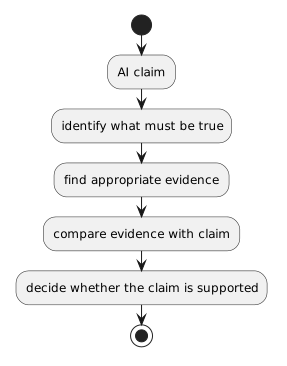
A useful mental model is:

Plain text
AI claim
   ↓
identify what must be true
   ↓
find appropriate evidence
   ↓
compare evidence with claim
   ↓
decide whether the claim is supported

The evidence controls the verification result.

The AI's confidence does not.

Verification Can Change What You Do With the Output

After verification, you might:

Verification is therefore part of decision-making, not a separate academic exercise.

The Main Habit

When an AI output contains an important factual claim:

  1. Identify the exact claim.
  2. Decide what kind of evidence could support it.
  3. Find evidence appropriate to that domain.
  4. Compare the evidence with the claim.
  5. State whether the claim is supported, contradicted, partly supported, or unresolved.

The next Learning Activity focuses on choosing a source with the right authority for that verification.