Generative AI can produce text that is:
Those qualities describe how the answer is presented.
They do not prove that the information is correct.
An AI-generated response can contain an error while sounding completely certain.
That is why appearance and accuracy must be evaluated separately.
A generative AI system uses its model, prompt, context, and available tools to generate an output.
It is not automatically checking every statement against an authoritative source before presenting it.
A response can therefore include:
The user should treat the response as generated output, not guaranteed evidence.
Imagine an AI response says:
The Wildcats' match begins at 4:30 p.m. on Field 3.
The sentence is specific.
That specificity does not prove that the system had access to the real schedule.
The time and field could be:
The more a task depends on an exact fact, the more important it becomes to notice whether that fact has real support.
Suppose a user asks:
What did my instructor say about the due date?
but the AI does not have the instructor's announcement.
A generated answer may still sound plausible if the system tries to be helpful.
The correct response depends on actual course information that may not be available.
A useful habit is to ask:
Did the AI actually have access to the information needed for this claim?
An AI response may sometimes mention:
A citation-shaped detail is still generated output unless the system actually retrieved or was given the source.
Do not assume that a source exists because its title looks realistic.
Some questions depend on information that changes:
An AI system may or may not have access to current external information.
A model that cannot access current information cannot reliably know a change that occurred after the information available to it.
Always distinguish:
general knowledge
from:
current factual state.
If the prompt contains an incorrect assumption, the output may continue from that assumption.
For example:
Explain why every soccer match has four 20-minute quarters.
The prompt itself presents a questionable premise.
A generated response may follow the requested framing instead of correcting it.
Good AI use includes evaluating the input as well as the output.
A response can be factually reasonable but still wrong for the situation.
Suppose you ask:
What should I wear?
Without information about:
the system has very little context.
A generic answer may not fit the actual need.
AI systems can use confident language for correct and incorrect statements.
Phrases such as:
Definitely...
The correct answer is...
This always means...
should not be treated as proof.
Evaluate the substance of the claim rather than the confidence of the writing.
An AI response does not have to be perfect to be useful.
A draft can help a user:
The important distinction is between:
useful starting material
and:
information that can be trusted without evaluation.
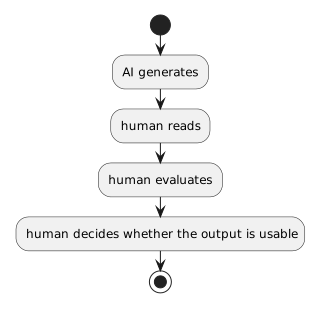
When working with generative AI, keep this sequence in mind:
AI generates
↓
human reads
↓
human evaluates
↓
human decides whether the output is usable
The next Learning Activity focuses on three qualities to examine during that evaluation: accuracy, credibility, and relevance.