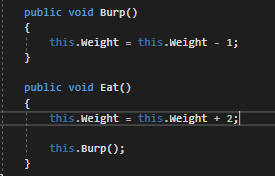
Currently, both methods increment the Employee's Weight field in the most basic way. For instance, in the Eat method, the Weight field is being assigned 2 more than the Weight field. In English this can be stated as "The Weight of the Employee (140) is now going to be the Weight of the Employee (140) plus 2."
When the = operator is used there truly isn't any "math" taking place. What is really happening is the field is being assigned to an equation that uses the value the field is holding.
In programming this is important because the method should really never know or care what the Weight of the Employee is. All the method really cares about is adding 2 to whatever the Weight of whatever Employee is gaining Weight.
If the methods here would run and the Employee was 140lbs, the Employee would eat and their new Weight would be 142. Then, the Employee would Burp and their new Weight would be 141.
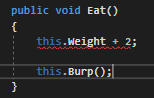
Code such as the following will error because there is no assigning taking place so Visual Studio doesn't know what to do.
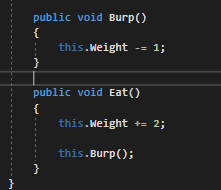
The incrementation above is very drawn out, but can be easier to understand. There is a shorter version, however, that uses +=. To implement it, remove the second field reference and replace the =+ with +=. In English this is the same as "The Weight field is assigned the Weight field plus 2." This can also be done with subtraction.
There is also an even shorter way to increment if the value you need to increment by is only 1. For instance, in the Burp method, the Weight is only being decreased by 1 so it can be changed to...
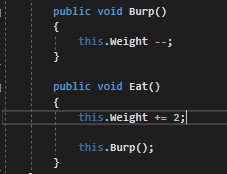
However, since the Eat method increments by 2, the shorthand cannot be used.