Compute One Result from Many Values
- New
- Changed
- Removed
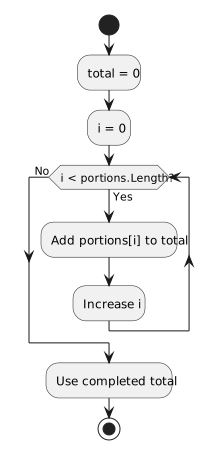
The running totals are 0.5, 1.25, and 2.25. Adding only after the loop would lose access to the current index; returning during the first pass would report an incomplete total. The final value is read after the condition becomes false.
If the calculation is a count instead of a sum, add one for each qualifying element. Separate the traversal pattern from the operation performed on each visited item.
Trace the Outcome
Trace an empty array and an array containing one value. In both cases, identify where the final result is available.