A NullReferenceException Means Code Tried to Use an Object Through null
An object reference can either refer to an object or have the value:
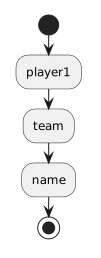 Player.
To reach name, the program first needs:
- player1 to refer to a Player object;
- player1.team to refer to a Team object.
If player1.team is null, the program cannot continue to .name.
Find the First null Reference in the Chain
Imagine the debugger shows:
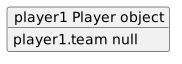 Player1PlayerObject.
Now the failure is more precise.
The problem is not that player1 is null.
player1 exists.
The nested reference:
does not currently point to a Team object.
That is the reference you need to explain.
Connect the Runtime State to the Object Model
Suppose the UML object diagram says:
player1 : Player -------- team1 : Team
The model expects a relationship between those two objects.
If the C# runtime state shows:
then the runtime object does not yet represent the modeled relationship.
That gives you an evidence-based diagnosis:
Use the Autos Window to Inspect the Reference
Pause at or immediately before the failing statement.
In Autos, inspect:
Expand the object.
Find the relevant nested field.
For example:
player1
  name = "Jordan"
  team = null
The debugger shows the state that caused the member-access chain to fail.
Do Not Assume Which Reference Is Null
Consider:
Possible null references include:
- player1 ;
- player1.team ;
- player1.team.coach .
The exception type alone does not tell you which one.
Inspect the chain step by step.
That habit becomes increasingly important as object relationships become deeper.
Diagnose Before Editing
A strong process is:
- Identify the failing statement.
- Break the member-access chain into steps.
- Inspect each reference in order.
- Find the first reference whose value is null .
- Compare that state with the UML or requirement.
- Determine which earlier relationship assignment should have established the reference.
This is better than adding random object creation statements.
Do Not Automatically Create a New Object at the Failure Point
Suppose:
The quick reaction might be:
player1.team = new Team();
That creates a Team object.
It may be the wrong Team object.
If the UML already contains:
the intended correction may be to connect player1 to that existing team1.
The model controls which object relationship is required.
Null Can Be a Valid Temporary State
A reference field can begin as null by default.
The presence of null is not automatically a defect.
It becomes a problem when the program attempts an operation that assumes an object exists there.
Ask:
The requirement and sequence answer that question.
The Main Diagnostic Sentence
When you encounter a NullReferenceException, work toward a sentence such as:
That sentence identifies:
- the object that exists;
- the reference that is null;
- the member access that fails.
A precise diagnosis makes the correction much easier to reason about.