Artificial intelligence, or AI, is a broad term for computer systems designed to perform tasks that involve patterns, predictions, classifications, decisions, or generated outputs.
Different AI systems can do very different kinds of work.
Examples include systems that:
There is no single task that defines every AI system.
A computer system does not experience the world the way a person does.
It receives data in a form it can process.
An AI model uses patterns learned or configured through its development process to produce an output for a new input.
For example, a system might receive:
an image
and produce:
a label
Another system might receive:
a written prompt
and produce:
a written response
The input and output depend on the kind of AI system.
A classification system chooses among defined categories.
For a simple instructional soccer example, imagine a system given photographs of equipment.
It might classify an image as:
soccer ball
goal
cone
jersey
The system is not generating a new photograph.
It is assigning a category to the input.
An AI system can also produce a prediction.
A system might estimate:
A prediction is a model-produced result.
It is not the same thing as certainty.
Recommendation systems use information about items, users, or prior interactions to rank possible choices.
For example, a music service might recommend songs based on patterns in listening behavior.
The system is not proving that the recommended song is the best possible choice.
It is producing a result from its model and available information.
Generative AI systems can produce new outputs such as:
That is one important category of AI, but it is not the entire field.
A spam classifier and a text generator can both be AI systems even though their outputs and purposes are very different.
A system's output can be influenced by:
Two AI systems can receive the same input and produce different results.
The same system can also produce different outputs for similar inputs.
Suppose you ask:
Help me with soccer.
That request leaves many possibilities.
You might want:
A more specific input gives the system more information about the desired task.
That idea becomes central when you work with prompts.
An AI result does not remove the need for a person to understand the task.
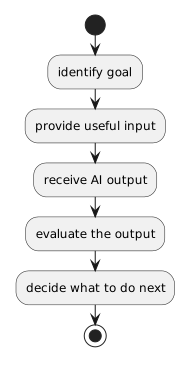
A useful human workflow can include:
identify goal
↓
provide useful input
↓
receive AI output
↓
evaluate the output
↓
decide what to do next
The AI contributes to the process.
The human remains responsible for deciding whether the result is useful for the task.
When you encounter an AI tool, ask:
What kind of input does this system accept?
What kind of output does it produce?
What task is it designed to help perform?
Those questions are more useful than assuming that all AI systems work the same way.
The next activity focuses specifically on generative AI systems.