A Responsible AI Workflow
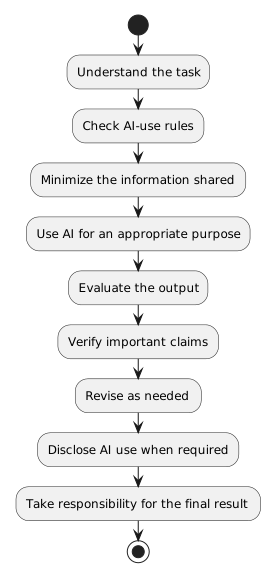
A useful process is:
- New
- Changed
- Removed
AI is most useful when it remains one tool inside a deliberate human process.
AI can help you:
The final decision to use the output still belongs to the person doing the work.
Responsible use means understanding the task, evaluating the result, and following the rules that apply to the situation.
Different courses, employers, clients, and projects can have different expectations for AI use.
One activity may permit AI-assisted brainstorming.
Another may limit AI use.
A workplace may authorize one system and prohibit another for confidential data.
Do not assume one universal rule.
Check the requirements that apply to the current work.
Transparency means making AI involvement visible when the context requires it.
For example, a course or workplace may require you to disclose that AI helped:
Follow the required disclosure format when one exists.
Do not invent a disclosure requirement when the current rules do not require one.
The principle is to avoid presenting AI-supported work in a way that falsely implies a different creation process.
Copying an AI answer into a technical task without understanding it creates risk.
If the output contains:
you should understand enough to judge whether it fits the requirement.
A result that you cannot explain is difficult to defend, troubleshoot, or revise.
AI can offer options.
A person should decide which option is appropriate.
For example, AI might generate three possible technical-help messages.
You choose the one that:
The AI produces candidates.
You make the decision.
Suppose you do not know whether a technical claim is correct.
Do not ask AI for a confident sentence and then present that sentence as if the uncertainty disappeared.
Instead:
Responsible use makes uncertainty clearer, not less visible.
Responsible AI use includes controlling what information is shared.
Do not include sensitive or unnecessary data merely to make the prompt more detailed.
Use:
when they can accomplish the same learning purpose.
If AI summarizes a source, compare the summary with the original before relying on it.
A generated summary can:
The original authoritative source still controls the factual meaning.
Some tasks are designed to measure:
If the assignment requires your own performance, use AI only within the permitted boundary.
A tool should support the learning goal rather than remove the learner action the task is intended to assess.
A good AI practice for one task may be inappropriate for another.
For example:
Low-risk creative brainstorming
may require little verification.
A current policy claim
requires authoritative evidence.
Confidential technical data
may require avoiding an unapproved AI tool entirely.
The task determines the level of care.
A useful process is:
AI is most useful when it remains one tool inside a deliberate human process.