2.2 Airline Learning Activity

Under Construction

This page is currently being built. Please check back soon.
A platypus
2.2 Airline Learning Activity — overview

Use the goals, acceptance criteria, and nested tasks below to prepare and complete this activity. Follow the stated scope carefully.
1.Gather your resources
A Open the assignment resources
Go to the completion checklist
Represent the class view
2.Review the notation example
A Identify the notation used in this view
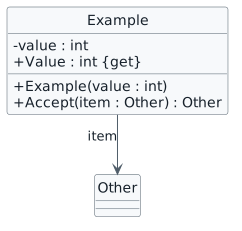
Class diagram notation example. class Example { - value : int + Example(value : int) + Value : int {get} + Accept(item : Other) : Other } Example --> Other : item
Class diagram notation example
  • New
  • Changed
  • Removed
2.2.1 How to Represent Object Returns in a Class Diagram
3.Open your 2.1 Airline Class Diagram
A Verify the required change or observation

Check the result against this instruction: Open your 2.1 Airline Class Diagram

4.Add a return to the OpenCargoDoor method in the Jet class of type Bag
A Verify the required change or observation

Check the result against this instruction: Add a return to the OpenCargoDoor method in the Jet class of type Bag

5.Add a method to the Gate class named PunchTicket that takes a parameter named ticket of type Ticket and returns a Ticket
A Verify the required change or observation

Check the result against this instruction: Add a method to the Gate class named PunchTicket that takes a parameter named ticket of type Ticket and returns a Ticket.

6.Verify the diagram against the evidence
A Inspect the rendered diagram

Open or render your diagram, inspect every label and relationship, and compare it with the code or debugger state. Resolve syntax errors, clipped labels and unreadable crossings before submission.
Represent the sequence view
7.Review the notation example
A Identify the notation used in this view
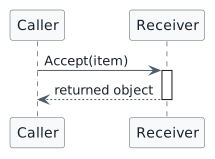
Sequence notation example. participant Caller participant Receiver Caller -> Receiver : Accept(item) activate Receiver Receiver --> Caller : returned object deactivate Receiver
Sequence notation example
  • New
  • Changed
  • Removed
2.2.2 How to Represent Object Returns in a Sequence Diagram
8.Open your 2.1 Airline Sequence Diagram
A Verify the required change or observation

Check the result against this instruction: Open your 2.1 Airline Sequence Diagram

9.Add a return to the OpenCargoDoor method call of type Bag
A Verify the required change or observation

Check the result against this instruction: Add a return to the OpenCargoDoor method call of type Bag.

10.Add a call to PunchTicket from inside the ConfirmArrival method. Have the method take a parameter named ticket of type Ticket and return a type of Ticket
A Verify the required change or observation

Check the result against this instruction: Add a call to PunchTicket from inside the ConfirmArrival method. Have the method take a parameter named ticket of type Ticket and return a type of Ticket.

11.Verify the diagram against the evidence
A Inspect the rendered diagram

Open or render your diagram, inspect every label and relationship, and compare it with the code or debugger state. Resolve syntax errors, clipped labels and unreadable crossings before submission.
Represent the activity view
12.Review the notation example
A Identify the notation used in this view
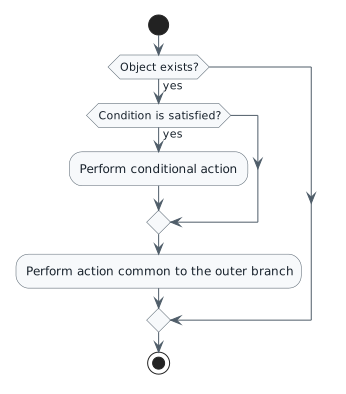
Nested decisions example. start if (Object exists?) then (yes) if (Condition is satisfied?) then (yes) :Perform conditional action; endif :Perform action common to the outer branch; endif stop
Nested decisions example
  • New
  • Changed
  • Removed
2.2.3 How to Represent While Loops in an Activity Diagram
13.Open a new Activity Diagram in Violet
A Verify the required change or observation

Check the result against this instruction: Open a new Activity Diagram in Violet.

14.Create an Activity Diagram that represents the code below
while (this.NumberOfBags > 0)
{
    this.NumberOfBags--;
}
A Verify the required change or observation

Check the result against this instruction: Create an Activity Diagram that represents the code below.

15.Verify the diagram against the evidence
A Inspect the rendered diagram

Open or render your diagram, inspect every label and relationship, and compare it with the code or debugger state. Resolve syntax errors, clipped labels and unreadable crossings before submission.

Save and Zip diagrams and submit to the Feedback System and Canvas
16.Save and submit
A Carry out the source requirement

Save and Zip diagrams and submit to the Feedback System and Canvas

Completion checklist
17.Review the required evidence
A Check every acceptance criterion

Return to each user story and confirm that you can demonstrate its acceptance criteria. Use the task checkboxes to track completion; a checked box is not a substitute for testing or inspecting the required evidence.

Represent the class view Represent the sequence view Represent the activity view
B Follow this activity’s submission instructions

Use the submission or attendance instructions in this page. For a Feedback System submission, upload the requested ZIP, review and resolve the feedback, and submit the resulting URL to the matching Canvas activity. For a Canvas quiz, enter only the requested answers; for an oral final, complete the scheduling and attendance steps.