Implement the changes specified in the following UML class diagram.
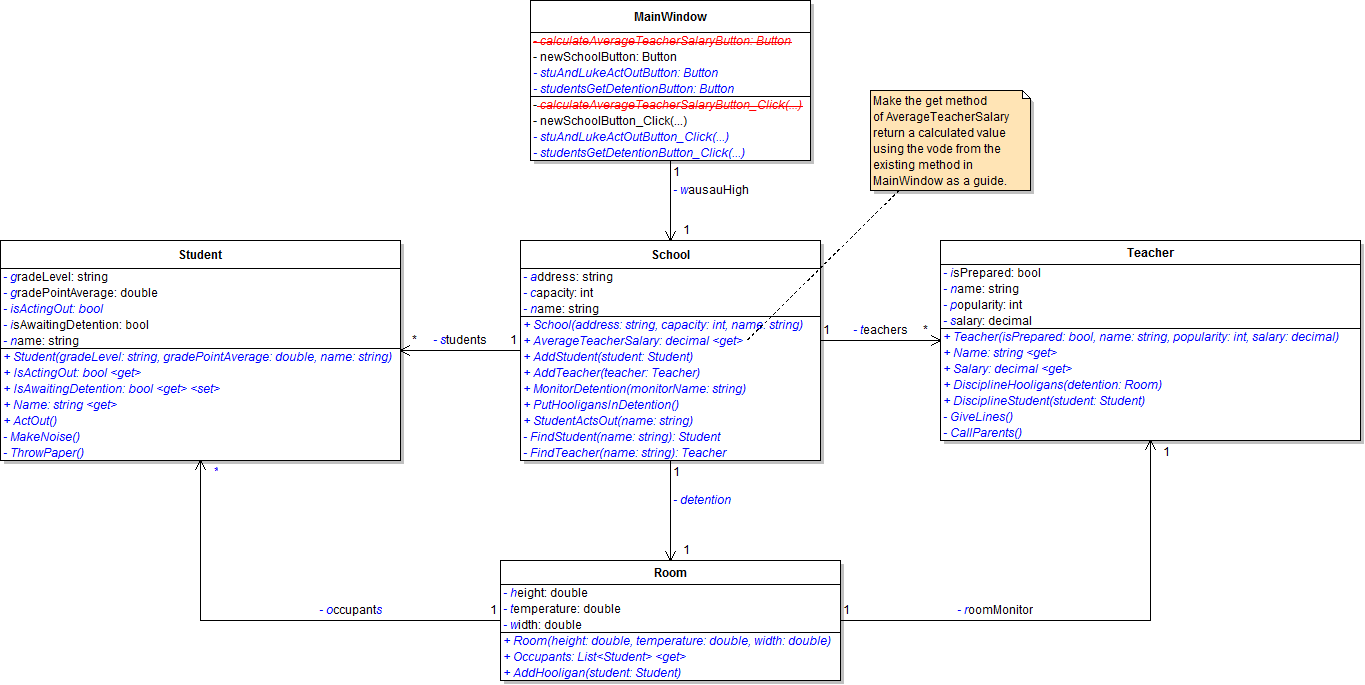
When creating classes be sure to:
Ensure the class in the root namespace. This can be done in one of two ways. Either by adding the class in the project, i.e. scenario, or by adding the class to the business classes folder and removing the ".Business_Classes" designation from the namespace.
Open the main window (MainWindow.xaml) in designer mode (right-click and click "View Designer" or press Shift-F7 to go to designer mode).
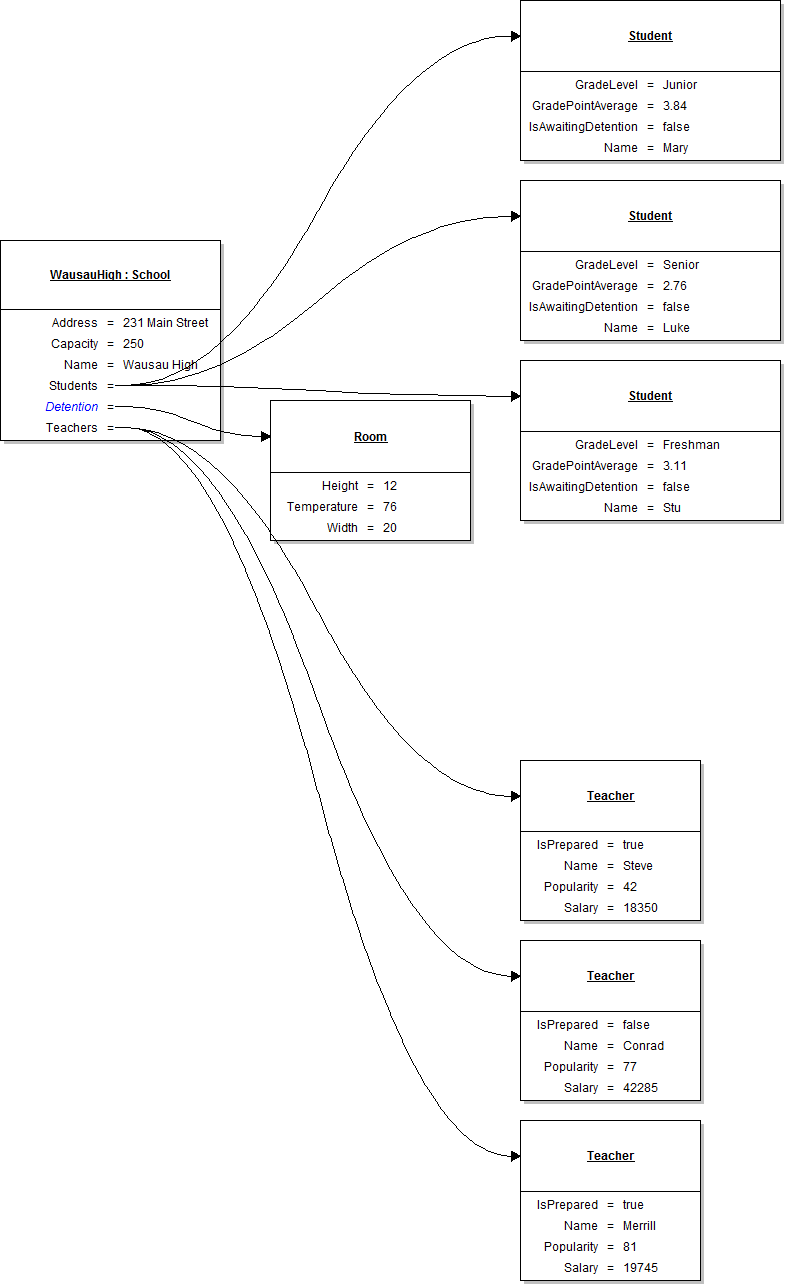
5.3 School Test: Object Diagram
Instantiate the objects and set their field values as specified in the following UML object diagram.
5.3 School Test: Code Snippet
Within the newSchoolButton click event handler use the following code snippet as your guide to writing the code.
5.3 School Test: Sequence Diagram 1
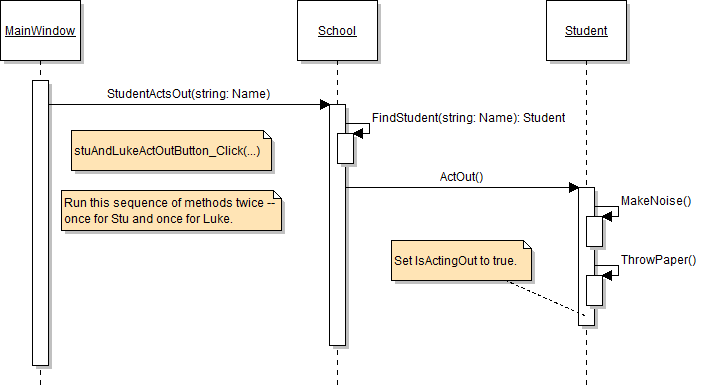
stuAndLukeActOutButton
5.3 School Test: Sequence Diagram 2
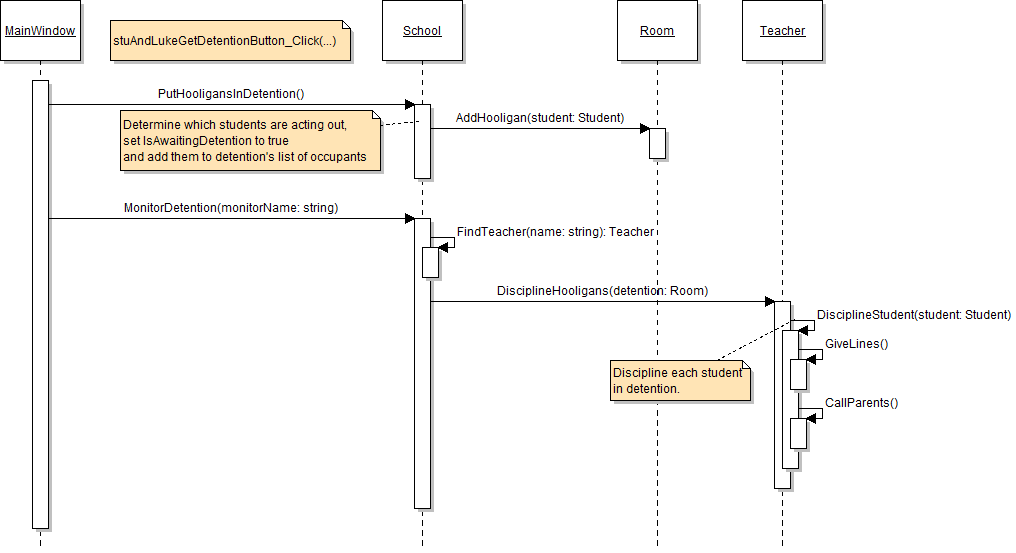
stuAndLukeGetDetentionButton
5.3 School Test: Final Steps
Button details:
Write code in the "Stu and Luke act out" button click event handler to implement the code specified in the sequence diagram.
Write code in the "Stu and Luke get detention" button click event handler to implement the code specified in the sequence diagram.
Test script:
Click the "New theater" button.
Click the "Stu and Luke act out" button.
Use the debugger to ensure that methods are called and fields are set as specified on the sequence diagram.
Click the "Stu and Luke get detention" button.
Use the debugger to ensure that methods are called and fields are set as specified on the sequence diagram.
Starting Zip File
Unzip the Test 2-Retake zip file, rename both the folder and the solution file to contain your last name, and use it as the starting point for your test.
Test Rubric
Test, Complete and Submit
Build your program - Eliminate compiler errors and warnings
Debug/Test your program - Set breakpoints, step through code, monitor values
Make your code StyleCop-compliant
Close your Visual Studio solution.
Compress your Visual Studio solution to a zip file.